
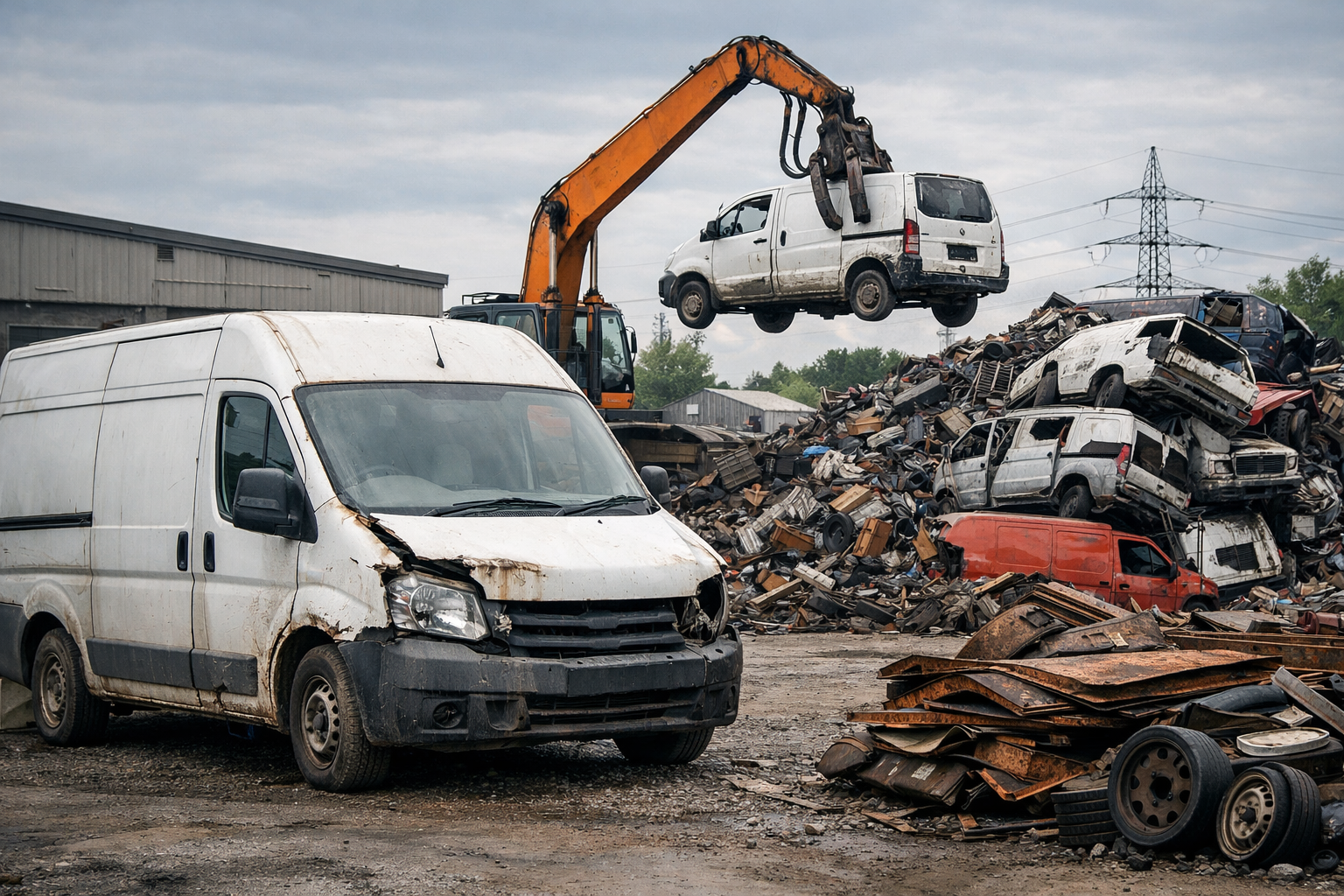
When scrapping a fleet van in the UK, businesses must follow a specific legal process — and there are three things most operators overlook: the VAT treatment of scrap proceeds, bulk collection logistics, and telematics data removal before handover. Get these right and the process is straightforward. Miss them and it costs you.
What does scrapping a fleet van actually involve?
Scrapping a fleet van means disposing of an end-of-life commercial vehicle through an Authorised Treatment Facility (ATF) — a DVLA-approved site licensed to legally depollute and recycle the vehicle. The ATF issues a Certificate of Destruction (CoD), which formally removes the vehicle from your fleet register and ends your legal liability for it.
This is not the same as part-exchange or auction. Those routes assume the vehicle has residual road value. Scrapping is the right route when a van is damaged beyond economic repair, has failed its MOT terminally, or has simply reached the end of its useful commercial life.
Until a CoD is issued and submitted to the DVLA, you remain the registered keeper. Road tax and insurance obligations do not end at handover — they end at CoD.
VAT on scrap proceeds: what fleet managers often get wrong
Scrap metal and salvage proceeds are VATable. When a business sells a fleet van for scrap, the payment received is subject to VAT at the standard rate — currently 20%. The ATF or scrap buyer should issue a VAT invoice, and your business must account for that output VAT on your VAT return.
Where this catches people out: if your fleet vans were purchased under a VAT-inclusive arrangement and input tax was blocked (common with cars adapted as vans), the VAT recovery position on disposal can differ. Always confirm with your accountant whether the vehicle was originally subject to input tax block before assuming the scrap proceeds are fully VATable in your favour.
For businesses registered under the VAT Margin Scheme or the Second-Hand Goods Scheme, different rules apply. Fleet van end-of-life disposals through an ATF typically fall outside those schemes, but the interaction is worth checking if your business operates in vehicle trading.
Request a VAT receipt from the ATF on the day of collection. Reconstructing paperwork weeks later for a VAT return is avoidable admin.
Bulk collection logistics: moving multiple vans efficiently
Commercial fleet disposal in the UK becomes a logistics exercise the moment you have more than two or three vans to move. Driving each van individually to an ATF is rarely practical — particularly if vehicles are non-runners, spread across multiple depots, or need to be cleared within a tight operational window.
The practical options are:
- Transporter collection — a flat-bed or multi-car transporter collects several vans in a single visit. Most reputable scrap buyers serving fleets can arrange this.
- Depot clearance — the buyer sends a team to a single site and processes all vehicles in one day, issuing paperwork for each individually.
- Rolling disposal — vans are collected as they reach end-of-life rather than in a single batch. Useful for fleets where vehicles age at different rates.
Agree the logistics in writing before any van moves. Confirm: who arranges transport, who bears the cost, whether non-runners are included, and what the per-vehicle scrap value is for each unit. Bulk collections often attract a better per-van rate — but only if you negotiate that upfront.
If you are disposing of a single van rather than a full fleet, the process is simpler. You can get a quote to scrap your van directly and arrange collection without the logistics complexity that comes with multiple vehicles.
Wiping telematics and data before handover
This is the step almost every piece of business van scrappage guidance skips — and it is the one with the most serious compliance implications.
Modern fleet vans carry telematics units that log driver behaviour, GPS routes, fuel usage, and in some cases video footage from dashcams. That data belongs to your business. It may also contain personal data about named drivers, which means it falls under UK GDPR.
Before any van leaves your possession for scrapping, you must:
- Remove or factory-reset the telematics unit (or instruct your telematics provider to remotely wipe the device)
- Delete or transfer any dashcam footage stored on SD cards or onboard memory
- Disconnect and retrieve any Bluetooth-paired devices or key fobs that retain vehicle access
- De-register the van from any fleet management software or fuel card systems
Failure to wipe telematics data before scrapping is not just a data hygiene issue. If a driver’s personal data is recoverable from a scrapped vehicle, you may have a UK GDPR breach on your hands. Document the wipe process for each vehicle as part of your disposal records.
Simply removing the SIM card from a telematics unit does not erase stored data. A full factory reset or physical destruction of the unit is required.
How the fleet van scrapping process works
Assess and catalogue your fleet
List every van earmarked for disposal. Record the registration, VIN, current condition, and whether the vehicle is a runner or non-runner. This catalogue drives everything — pricing, logistics, and paperwork.
Get valuations from ATF-registered buyers
Contact at least two or three buyers who operate as, or work directly with, Authorised Treatment Facilities. Provide your catalogue. For bulk disposals, ask for a per-vehicle rate and confirm whether collection is included.
Wipe telematics and remove personal data
Before any vehicle moves, complete the data removal process described above. Document each step. This is not optional.
Arrange collection or delivery
Confirm transport logistics in writing. For non-runners, ensure the buyer has the right recovery equipment. For bulk collections, agree a date and site access arrangements with your depot manager.
Receive Certificates of Destruction and update your records
Each vehicle must have its own CoD. Submit notifications to the DVLA, update your fleet management system, cancel insurance for each unit, and file the CoD with your disposal records. Retain these for at least six years for VAT and compliance purposes.
Who is this for?
This process applies to any UK business operating a commercial van fleet — from a sole trader with two Transit vans to a national logistics operator clearing dozens of vehicles a year. It is equally relevant to:
- Fleet managers at mid-size businesses handling their own disposals
- Finance directors responsible for VAT compliance on asset disposals
- Operations managers coordinating depot clearances
- HR and compliance teams with responsibility for driver data under UK GDPR
If your business leases its vans, check your lease agreement before arranging scrapping. Some finance agreements require the vehicle to be returned to the leasing company at end-of-life rather than disposed of independently.
Why use a specialist fleet scrap buyer?
A specialist buyer — one who understands commercial fleet disposal in the UK — does more than collect a van. They issue correct VAT documentation. They arrange multi-vehicle collection without you managing a logistics chain. They operate through ATFs, so your CoDs are legally watertight.
General scrap yards are not always equipped for fleet volumes or the paperwork that comes with them. A buyer who handles business van scrappage regularly will have a process for bulk CoD issuance, VAT receipts, and data destruction confirmation — because their fleet customers demand it.
Ask any prospective buyer three questions before committing: Are you an ATF or do you use one? Can you provide a VAT receipt on the day? Do you confirm telematics removal in writing? If the answers are no, no, and no — keep looking.
- Scrap proceeds are subject to VAT; always obtain a VAT receipt from the ATF on collection day
- Bulk collection logistics should be agreed in writing before any van moves
- Telematics data and dashcam footage must be wiped before handover — this is a UK GDPR obligation
- Every scrapped van requires its own Certificate of Destruction; retain these for at least six years
- Specialist fleet scrap buyers offer correct VAT documentation, multi-vehicle collection, and ATF-compliant disposal
Get a quote for your fleet disposal
Ready to move your end-of-life vans? Tell us how many vehicles you have, where they are, and their condition. We handle bulk collection, issue VAT receipts on the day, and provide a Certificate of Destruction for every vehicle. No guesswork. No chasing paperwork.
Contact us today for a fleet disposal quote — and clear your yard without the admin headache.