
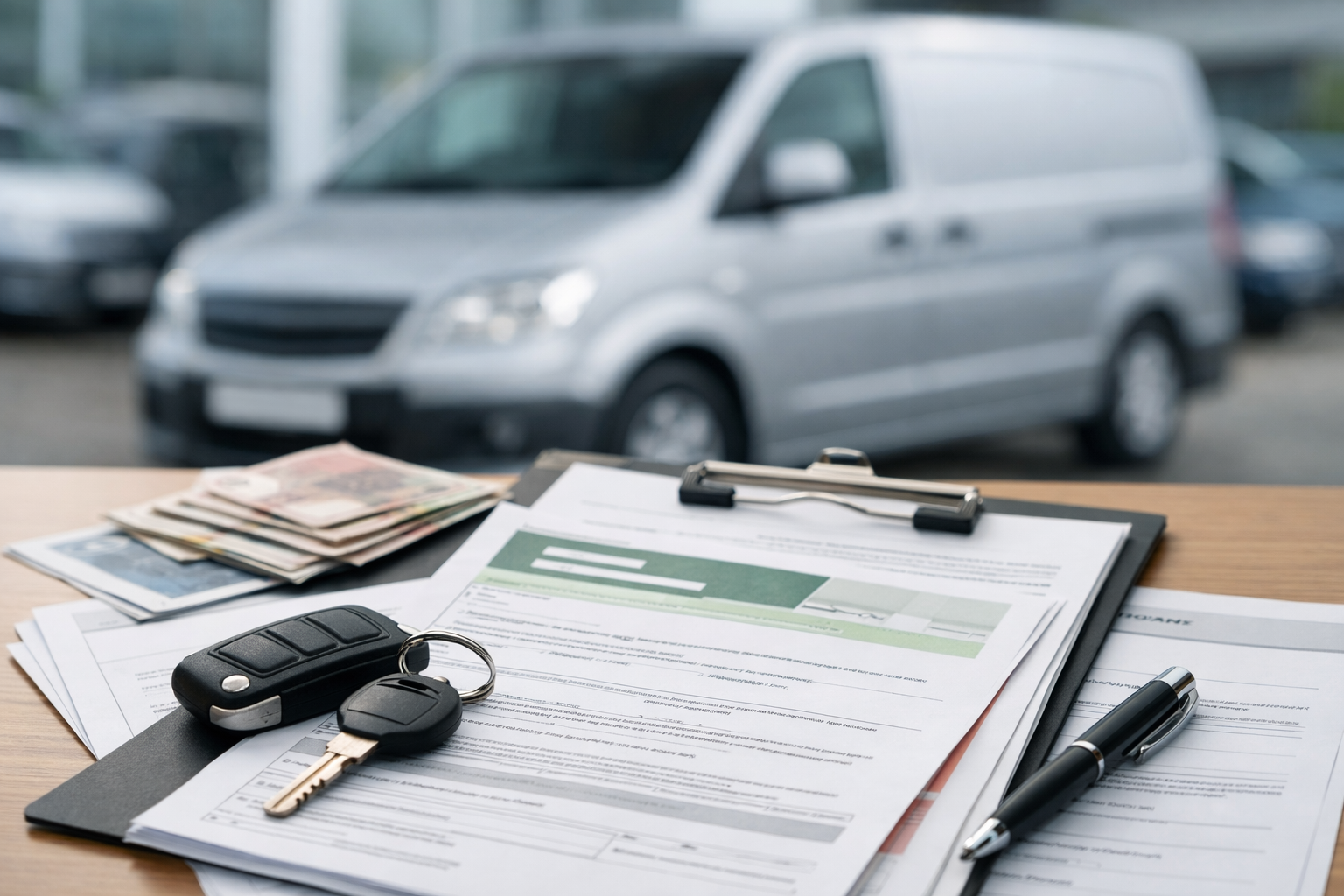
To sell a van legally in the UK, you need the V5C logbook, a valid MOT certificate (for vans over three years old), proof of any outstanding finance settlement, and — if you want to protect yourself from future disputes — a signed bill of sale. That is the short answer. The longer answer involves a stack of paperwork that most sellers either forget about, get wrong, or cheerfully hand over to a buyer without keeping a single copy, and then spend the next six months arguing with DVLA about a vehicle they no longer own.
This article covers every document you need to sell a van in the UK in 2025, what each one actually does, and — crucially — what to do when one of them is missing. Because here is the thing: every other guide on this subject either lists the documents and stops there, or is really a car-sale guide with the word “van” inserted at tasteful intervals. Neither is any use if you are trying to shift a 3.5-tonne Sprinter with a tail lift, a missing service book, and a finance agreement you had almost forgotten about.
Key takeaways
- The V5C logbook is the cornerstone document — no V5C means no straightforward sale, but it does not make the sale impossible
- Road tax does not transfer to the buyer; it cancels automatically when you notify DVLA, and you get a refund for full months remaining
- Outstanding finance must be settled before you sell — selling with undisclosed HP is not a grey area, it is fraud
- Commercial vans have additional paperwork that car-sale guides never mention: plating certificates, conversion paperwork, ULEZ evidence, and VAT invoices
- A bill of sale is not legally required but is the single cheapest form of protection you will ever buy yourself
Why the Right Documents Matter When Selling a Van
The legal position is simple, which is to say it is the kind of simple that comes back to bite you at three in the morning. Until DVLA is properly notified of a sale, you remain legally responsible for the vehicle. That means if the buyer drives it into a hedge, fails to pay a congestion charge, or uses it to commit some act of spectacular idiocy, the paperwork trail leads back to your front door.
Beyond liability, missing documents collapse sales. A private buyer gets nervous. A trade buyer gets suspicious. A fleet operator gets their legal team involved, and suddenly your straightforward van sale has become a correspondence project that outlasts most relationships.
Vans are also not cars with a higher roof. Commercial vehicle buyers — dealers, fleet managers, sole traders — run history checks and scrutinise mileage records in ways that private car buyers rarely bother with, because the stakes are higher. A van that has done 180,000 miles delivering parcels has lived a very different life from a car that has done the same distance on the motorway, and experienced buyers know this. Your paperwork either confirms the story or raises questions about it.
This guide covers every document in roughly the order of importance, explains what each one does, tells you what to do if it is missing, and finishes with a checklist you can actually use rather than simply admire.
The V5C Logbook — Your Most Important Document
The V5C — also called the logbook — is the DVLA’s record of who is responsible for a vehicle. It is not proof of ownership (a distinction that matters enormously if finance is involved, as we will get to), but it is the document every buyer expects to see, every trade buyer demands to see, and every scammer will try to forge. It is the cornerstone of any van sale.
Before you do anything else, check that the V5C details actually match the van sitting on your drive. The VIN (Vehicle Identification Number — the unique 17-character code stamped on the van’s chassis and visible through the windscreen) must match the number on the V5C. So must the engine number, the colour, and the body type. If they do not match, stop. Do not list the van. Contact DVLA to get it corrected first, because a buyer who spots a discrepancy will either walk away or use it to negotiate a price that makes you weep.
If the V5C is still in a previous keeper’s name, that is a problem worth solving before you advertise. It suggests the previous sale was never properly notified to DVLA. You can apply to update the record, but the simplest route is to call DVLA directly and explain the situation — they have seen this before, many times, and can advise on the fastest fix.
What to do if you have lost the V5C: Apply for a replacement using the V62 form, available from any Post Office or downloadable from GOV.UK. It costs £25 and takes up to five working days. You can still sell the van without a V5C — it is not illegal — but you must be transparent with the buyer, explain that a replacement has been applied for, and expect the offer to reflect the additional uncertainty. Buyers are not unreasonable about this. They are, however, unreasonable about finding out after the fact.
The V5C contains a yellow slip at the back — Section 9, titled “sell, transfer or part-exchange your vehicle to a motor trader, insurer or dismantler” — wait, that is the green slip. The yellow slip is the new keeper supplement, which the buyer keeps. You, the seller, complete the main V5C and either send it to DVLA by post or notify them online at GOV.UK. Do this on the day of sale. Not the following week when you get round to it. On the day.
Pro tip
Notifying DVLA online takes about four minutes and gives you instant confirmation. Doing it by post takes up to four weeks and gives you a mild sense of unease until the confirmation letter arrives. Online is better.
MOT Certificate — What Van Sellers Actually Need to Know
Vans over three years old require a valid MOT — but here is the part that surprises people: the MOT class depends on the van’s weight. Most light vans (under 3,000 kg gross vehicle weight) take a Class 7 test. Larger vans and minibuses fall into Class 5. The wrong class of test is not a valid MOT, so check the certificate matches the van’s actual weight and category.
You can check the current MOT status of any van online via the DVLA’s free vehicle enquiry tool at GOV.UK. Do this before you list the van, share the link with serious buyers, and save yourself the conversation where they claim they “heard it failed last year.” The online record shows pass dates, failure reasons, and — importantly — advisory notes.
Advisory notes are where commercial buyers focus their attention, and rightly so. An advisory on a car is a mild concern. An advisory on a van that has been doing 40,000 miles a year is a flashing warning light. Corrosion on a load-bearing floor, worn brake components, suspension wear — these things matter more on a vehicle that has been working for a living, and a buyer who knows what they are doing will price accordingly.
Selling with a failed or expired MOT: You can sell a van without a valid MOT — it is legal, provided you are transparent about it and the buyer does not drive it away on the public road (unless they are driving directly to a pre-booked MOT test). You must disclose the failure or expiry. Do not bury it in the listing. Buyers who discover it themselves will assume you were hiding it, which is worse than the failed MOT itself.
Service History and Maintenance Records
Full service history is worth more on a van than on a car, because vans work harder, wear faster, and are bought by people who understand this. A fleet manager buying a replacement Transit does not care about the colour. They care about whether the timing belt was changed at the right mileage and whether the brakes have been properly maintained. The service book is the evidence.
What counts as acceptable service history in 2025 is broader than it used to be. Dealer stamps are ideal. Independent garage receipts are fine, provided they are on headed paper with dates and mileages. Digital service records — emailed invoices, online portals from franchise dealers — are increasingly common and perfectly acceptable. What is not acceptable is a vague claim that “it was always serviced regularly” with nothing to back it up.
Pull together every receipt you have: cam belt or timing chain replacements (with the mileage noted), tyre purchases, brake pad invoices, major repair records. These are not just supporting documents — they are the evidence that the van has been looked after, and they add real money to the sale price.
If your service history is incomplete: Be honest about it. Do not describe a van as having “partial service history” when what you mean is “one stamp from 2019 and a vague memory of an oil change.” Describe what you have, present what you can find, and price the van accordingly. Buyers can work with incomplete history. They cannot work with discovering they were misled about it.
Road Tax — The Bit That Catches Everyone Out
Road tax does not transfer to the buyer. Full stop. It cancels automatically the moment DVLA is notified of the sale, and you receive a pro-rata refund for any full calendar months remaining on the tax — paid back to the card or account originally used. You do not need to do anything extra to trigger this; it happens as part of the sale notification process.
The buyer must tax the van before driving it away. This is not optional and it is not your problem to solve — but it is your problem to explain clearly before handover, because if you do not, you will get a phone call forty minutes after the sale from a buyer who has been pulled over and is now furious with you for reasons that are entirely their own fault.
Pro tip
Check the current tax status of your van before listing it at GOV.UK’s vehicle enquiry service. If it has lapsed — perhaps because you laid the van up for a few months — a buyer will spot this and use it as a negotiating point, whether or not it is actually relevant to the sale.
Insurance Documents and What to Do Before Handover
Your insurance does not transfer to the buyer. This sounds obvious until you realise how many sellers hand over the keys without having this conversation, and how many buyers drive away assuming they are covered on the seller’s policy. They are not. They never were.
Advise any buyer — in writing, even if it is just a text message — that they must arrange their own insurance before collection. This is especially important for commercial vans, where the buyer may need specific goods-in-transit cover, fleet insurance, or trade plates rather than a standard private policy. A buyer who cannot arrange cover on the day is not your emergency, but it becomes your headache if they drive away uninsured and something goes wrong.
Keep a record of when you cancelled or amended your own policy, including the date and the insurer’s reference number. If a claim surfaces later relating to the van, you need to be able to demonstrate clearly that your cover had ended.
Short-term insurance and trade plates are options for buyers who need to drive the van away immediately but cannot arrange full cover on the same day. Several insurers offer daily or hourly commercial vehicle cover. Point buyers towards this option before the handover, not during it.
Finance Settlement Letter — If the Van Is on Finance
You cannot legally sell a van that is subject to outstanding hire purchase (HP) finance without settling it first. Under HP agreements, the finance company owns the vehicle until the final payment is made — not you. Selling it without their knowledge or consent is not a technicality, it is fraud. The buyer can lose the van to the finance company even after they have paid you in full, which is the kind of outcome that ends up in court.
If your van is on HP, contact your finance provider and request a settlement figure. This is the amount required to pay off the agreement in full. Settlement figures are usually valid for 10 to 28 days, so request it when you have a buyer lined up rather than the moment you decide to sell.
The situation is different for lease agreements: if the van is leased, you almost certainly do not have the right to sell it at all — the leasing company owns it outright. Check your agreement, call your provider, and do not assume.
Before listing any van, run an HPI check (or equivalent — there are several competing services). This will confirm whether any finance is registered against the vehicle, whether it has been reported stolen, and whether the mileage history is consistent. It costs around £20, takes five minutes, and is the kind of thing that either reassures buyers or saves you from an extremely awkward conversation.
Warning
Selling a van with undisclosed finance is not just a civil matter — it can constitute fraud under the Fraud Act 2006. The consequences include criminal prosecution, a requirement to repay the finance company, and the kind of reputational damage that follows you around. Settle the finance. It is not worth it.
Number Plate Retention — The V317 Form
If the van carries a personalised or cherished registration that you want to keep, you need to act before the sale completes, not after. The form you need is the V317, available from DVLA or online at GOV.UK, and it allows you to retain a registration and either put it on retention (on a certificate, for use later) or transfer it immediately to another vehicle.
There are conditions. The van must be currently taxed and have a valid MOT at the time you apply. If either has lapsed, you cannot retain the plate until both are restored — which is the kind of bureaucratic catch-22 that DVLA has elevated to an art form.
The process is straightforward enough:
Apply for retention before the sale
Submit the V317 form online or by post to DVLA. The online route is faster and gives you a reference number immediately. The fee is £80, which covers putting the plate on a retention certificate valid for ten years.
Assign a replacement registration to the van
DVLA will issue an age-appropriate replacement registration for the van. This goes on the vehicle before it is sold. You cannot sell a van with no registration number, and you cannot sell it with a plate that is in the process of being transferred — so get this sorted before you agree a handover date.
Complete the sale with the correct plates fitted
Once the replacement registration is confirmed and physically fitted to the van, the sale can proceed normally. The buyer gets the van with its new registration; you keep your cherished plate on a certificate to use whenever you like.
DVLA typically processes V317 applications within five working days online and up to three weeks by post. Factor this into your timeline.
Additional Documents That Strengthen a Van Sale
This is the section that separates a van sale from a car sale, and the section that every other guide on this subject either skips entirely or handles with a single vague bullet point. Pay attention, because this is where commercial buyers form their opinions.
Original purchase invoice: If you have the invoice from when you bought the van — whether from a dealer or a private seller — include it. It establishes provenance, confirms the purchase price (useful for buyers who want to understand the van’s history), and gives trade buyers confidence that the ownership chain is clean.
Warranty documents: Manufacturer warranties, extended warranties, and third-party cover plans should all be transferred to the new owner where the terms allow. Check whether the warranty is transferable — some are, some are not, and some require a transfer fee. If it is transferable, it adds genuine value. If it is not, say so rather than letting the buyer assume.
Recall completion certificates: Check whether your van has any outstanding safety recalls using the DVSA’s free recall checker at GOV.UK. If recalls have been completed, the dealer or repairer should have provided a completion certificate. If there are outstanding recalls, disclose them — a buyer who discovers an uncompleted recall after purchase will be significantly less amused than one who was told upfront.
Conversion and modification paperwork: This is the one that car-sale guides never mention. If your van has been fitted with a refrigeration unit, a tail lift, specialist racking, a high-roof conversion, or any other body modification, you need documentation for it. This means the installer’s certificate, any relevant type approval documents, and — for refrigerated vans used in food transport — temperature calibration records. Commercial buyers and fleet operators will ask for these. Not having them raises questions about whether the conversion was done properly and whether the van’s plated weight is still accurate.
ULEZ and CAZ compliance evidence: For vans being sold to buyers who operate in London or other clean air zones, Euro emission standard compliance is not a nice-to-have — it is the difference between a usable van and an expensive ornament. Your V5C shows the Euro standard in some cases, but the most reliable evidence is a check via TfL’s ULEZ checker (for London) or the relevant local authority’s CAZ checker. Print the result and include it with your documents. Urban buyers and fleet operators will thank you. Or, more accurately, they will not use it as a reason to reduce their offer.
Weighbridge and plating certificates for heavier vans: If you are selling a van over 3.5 tonnes gross vehicle weight, it requires a Ministry of Transport (MOT) test for heavier vehicles and, if used commercially, a plating certificate issued by DVSA. The plating certificate confirms the vehicle’s maximum permitted weights — gross vehicle weight, train weight, and individual axle weights. Without it, a commercial buyer cannot legally operate the vehicle. This is not a document you can reconstruct or substitute; if it is missing, contact DVSA to establish what can be done before you list the van.
VAT invoices and capital allowances records: If the van was owned by a business — including a sole trader — the buyer may need a VAT invoice to reclaim input tax. If you are VAT-registered, issue one. If the van was purchased with capital allowances claimed against it, keep records of this for your own tax purposes; HMRC will want to know about the disposal.
Writing a Bill of Sale — Protecting Yourself After the Transaction
A bill of sale is not a legal requirement for a private van sale in the UK. It is also the single cheapest form of protection you will ever arrange for yourself, because it creates a written record of exactly what was agreed, by whom, for how much, on what date. If the buyer comes back three months later claiming the van was not as described, your bill of sale is the document that ends the conversation.
It does not need to be complicated. A bill of sale for a van should include:
- The date of the sale
- The full names and addresses of both seller and buyer
- The van’s registration number and VIN
- The agreed sale price
- The odometer reading at the time of sale
- A brief description of the van’s condition
- A “sold as seen” clause if the van is being sold without warranty
- Signatures from both parties
If you are selling to a business buyer, add their company name and registration number. If you are selling a van that has known faults, list them — not to be helpful, but to protect yourself from a misrepresentation claim later.
Keep two copies: one physical, one digital. Email yourself the signed copy so it is date-stamped. Store the physical copy somewhere you will actually be able to find it in six months. A drawer is fine. The glove compartment of your next vehicle is not.
Note
A “sold as seen” clause does not override your legal obligations under the Consumer Rights Act 2015 if you are selling as a business. If you are a private seller, it provides reasonable protection. If you are a dealer or trading as a business, different rules apply and you should take legal advice.
Selling a Van With Outstanding Finance? Here Is What You Should Know First
If you have found yourself reading this article because you are trying to figure out how to sell a van that still has finance on it, the honest answer is: sort the finance first. If you are selling to a specialist buyer rather than a private individual, some buyers who specialise in commercial vehicles of all conditions will handle the finance settlement as part of the purchase process — they pay off the finance company directly and give you the difference. This is legal, clean, and significantly less stressful than trying to manage it yourself while also negotiating a sale price. Get the settlement figure from your lender, understand what equity (if any) remains in the van, and know your numbers before you start any conversation.
Checklist: Documents to Gather Before You List Your Van
Use this before you write the listing, not after you have agreed a price and the buyer is standing in your driveway asking questions.
Essential documents — do not list without these:
- V5C logbook (or V62 replacement application in progress)
- MOT certificate (valid, correct class for the van’s weight)
- Finance settlement letter (if applicable — confirm finance is cleared before listing)
- Any outstanding recall completion certificates
Strong to have — these protect you and add value:
- Full or partial service history (dealer stamps, garage receipts, digital records)
- Original purchase invoice
- Bill of sale (prepare this before the buyer arrives, not during the handover)
- Warranty documents (if transferable)
Commercial van-specific — essential for trade buyers and fleet operators:
- Plating certificate (for vans over 3.5 tonnes)
- Conversion or body modification certificates (tail lifts, fridge units, specialist bodies)
- ULEZ/CAZ compliance printout (for urban buyers)
- Weighbridge certificates (if relevant to the van’s use)
- VAT invoice (if selling as a VAT-registered business)
Before you share any documents online:
Warning
Redact personal information from any documents you photograph for a listing. Your V5C contains your name and address. Your service receipts may contain your home address. Crop, blur, or cover this information before uploading anything to a listing site. Identity theft is tedious and time-consuming and entirely avoidable.
Frequently Asked Questions
This FAQ covers the most common questions sellers ask about the documents needed to sell a van in the UK — including what to do when something is missing, what the law actually requires, and the paperwork that commercial van sellers often overlook.
Can I sell a van without a V5C logbook in the UK?
Yes, you can sell a van without a V5C — it is not illegal. You should apply for a replacement using the V62 form (available from any Post Office or GOV.UK), which costs £25 and takes up to five working days. Be transparent with the buyer about the missing document; most will accept it if you can explain the situation clearly, though they may offer a lower price to reflect the additional uncertainty. Never try to sell a van while claiming the V5C will “turn up” — if it has not turned up yet, it probably will not.
Do I need to tell DVLA immediately when I sell my van?
Yes — and “immediately” means on the day of the sale, not when you get round to it. You can notify DVLA online at GOV.UK in about four minutes, and you will receive instant confirmation. Until DVLA is notified, you remain legally responsible for the vehicle: any fines, charges, or incidents involving the van are associated with your details. Do not leave this until later.
What happens to road tax when I sell my van?
Road tax cancels automatically when DVLA is notified of the sale — you do not need to contact DVLA separately to cancel it. You will receive a pro-rata refund for any full calendar months remaining, paid back to your original payment method. The buyer must tax the van before driving it away; they cannot use your existing tax disc or assume they are covered under your policy.
Can I sell a van that still has finance outstanding on it?
Not legally, without settling the finance first. Under hire purchase agreements, the finance company owns the van until the final payment is made — selling it without their consent can constitute fraud under the Fraud Act 2006, and the buyer can lose the van to the finance company even after paying you in full. Request a settlement figure from your lender, clear the finance, and obtain written confirmation that the agreement is closed before you complete the sale.
Do I need an MOT to sell a van privately?
You do not legally need a valid MOT to sell a van privately, but you must be transparent about its MOT status. If the MOT has expired or the van has failed its test, disclose this clearly in the listing and in any conversation with the buyer. The buyer cannot legally drive the van on a public road without a valid MOT, except to drive directly to a pre-booked MOT test. Expect the price to reflect the van’s MOT status.
What is the V317 form and do I need it when selling a van?
The V317 is the form you use to retain a personalised or cherished registration plate from a vehicle before selling it. You only need it if you want to keep the plate — if you are happy for the registration to transfer with the van, you do not need it. If you do want to keep the plate, you must apply before the sale completes, the van must be taxed and have a valid MOT at the time of application, and DVLA will issue a replacement age-appropriate registration for the van. The fee is £80 and the process takes around five working days online.
Should I provide a bill of sale when selling a van privately?
A bill of sale is not legally required for a private van sale, but it is strongly advisable. It creates a written record of the agreed price, the van’s condition at the point of sale, the odometer reading, and the identities of both parties — and it is the document that protects you if the buyer later claims the van was misrepresented. Include a “sold as seen” clause if the van is being sold without warranty, and keep a signed copy (physical and digital) for at least two years after the sale.
What documents do I need if I am selling a van as a business?
If you are selling as a VAT-registered business, you must provide a VAT invoice to the buyer so they can reclaim input tax if they are also VAT-registered. You should also retain records of any capital allowances claimed on the van for your own HMRC reporting. Business sellers do not benefit from the same “sold as seen” protections as private sellers — the Consumer Rights Act 2015 applies, which means implied terms about satisfactory quality cannot be excluded by a simple disclaimer. If you are selling multiple vans regularly, take legal advice on whether you are trading in a way that triggers additional obligations.
Still have questions about the documents needed to sell a van in the UK? The situation with missing paperwork, finance complications, or specialist commercial vehicles can get complicated quickly. If you would rather not navigate it alone, speak to a specialist buyer who deals with exactly these situations every day — they have seen every permutation of missing logbook, outstanding finance, and obscure plating certificate, and they can tell you where you stand in about five minutes.
—SEO_DATA_START—
SEO_TITLE: Documents Needed to Sell a Van UK (2025 Guide)
SEO_DESCRIPTION: Find out exactly which documents you need to sell a van in the UK in 2025 — including what to do if your V5C, MOT or service history is missing.
SEO_FOCUS_KEYWORD: documents needed to sell a van UK
SEO_OG_TITLE: What Documents Do You Need to Sell a Van in the UK?
SEO_OG_DESCRIPTION: V5C, MOT,


