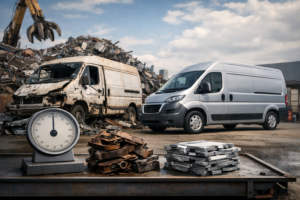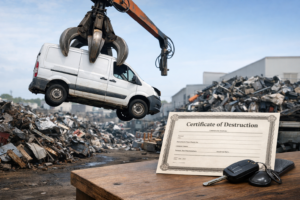
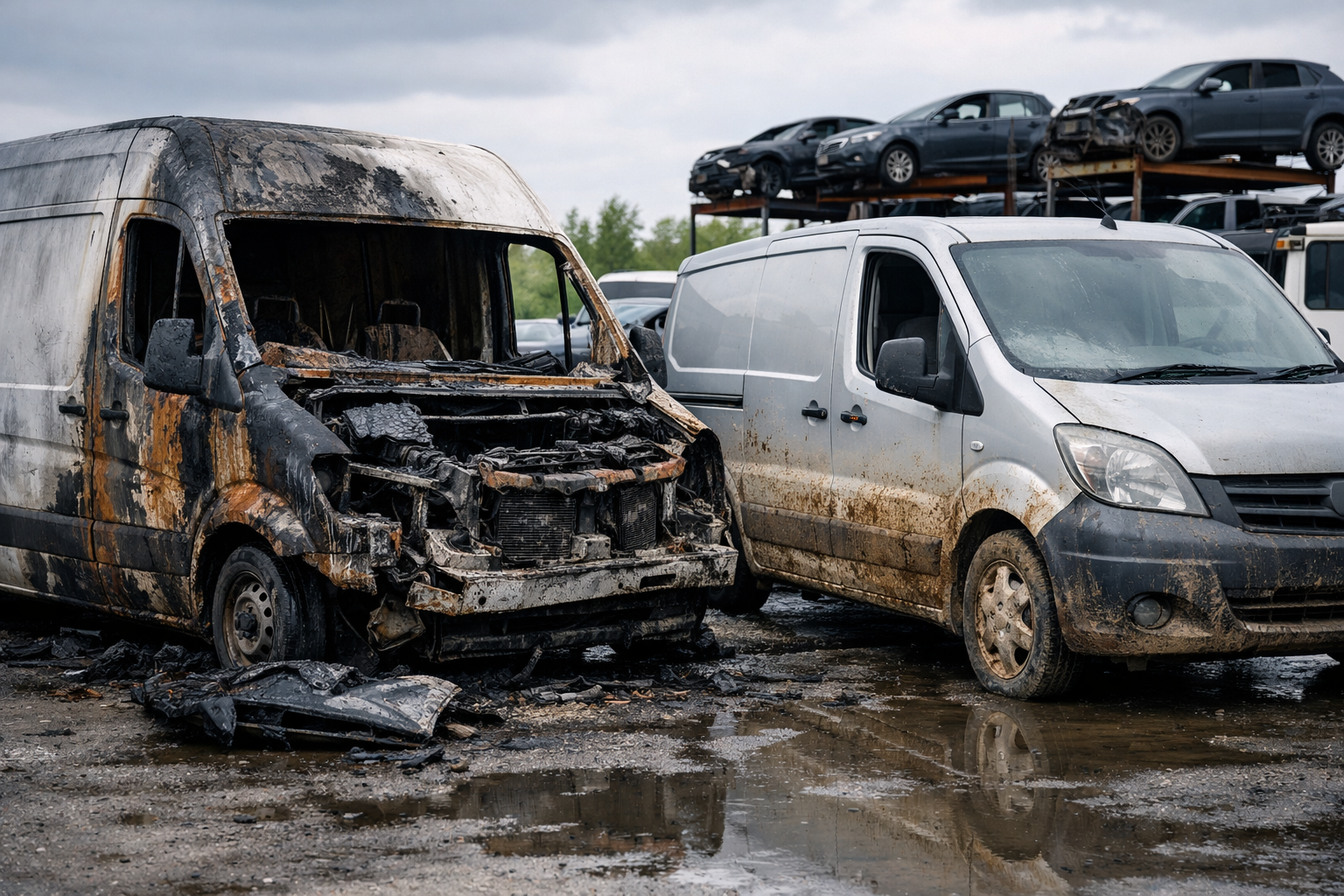
Your van is written off. Fire or flood has done the damage. Now what?
Whether it happened overnight in a car park or during last winter’s flooding, the question is the same: can you still sell it, and what will you realistically get? The answer is yes — you can sell a fire damaged van in the UK, and flood-damaged vans sell too. But the process has specific steps, and the price depends on factors most sellers don’t know about until it’s too late.
This guide covers everything: documentation, realistic offers, and how to avoid the traps that cost sellers money.
- Fire and flood damaged vans can be sold in the UK, but they must be correctly categorised under the insurance write-off system (Cat S, Cat N, or salvage)
- The documentation you gather before selling directly affects the offer you receive — missing paperwork costs money
- Specialist buyers move faster and pay more than general scrap dealers for fire or flood damaged vans
- Flood damage is often worse than it looks; buyers know this, and offers reflect it
- You can sell without going through your insurer, but there are legal obligations you must meet first
What happens to a van after fire or flood damage?
Fire and flood damage are different beasts, but they share one outcome: the van is almost certainly uneconomical to repair at retail prices. Insurers use a write-off category system to classify damaged vehicles.
The four categories you need to know:
- Category A — scrap only; the vehicle must be crushed entirely
- Category B — body shell must be crushed, but parts can be salvaged
- Category S — structural damage but can be repaired and returned to the road (previously Cat C)
- Category N — non-structural damage only; can be repaired and re-registered (previously Cat D)
Most fire and flood damaged vans fall into Cat S or Cat N, though severe cases land at Cat B. If your insurer has already assessed the van, they will have assigned a category. That category must be declared to any buyer and recorded on the V5C.
Selling a categorised write-off without disclosing its status is a criminal offence under the Road Traffic Act. Always declare it.
What documentation do you need to sell a fire or flood damaged van?
Good paperwork is the difference between a fair offer and a lowball one. Gather everything before you contact any buyer.
For fire damaged vans, you need:
- V5C logbook (or a V62 application if it was destroyed in the fire)
- Insurance assessor’s report, including the write-off category assigned
- Any fire investigation report if one was produced (useful for proving the cause and ruling out fraud concerns)
- MOT history printout from the DVLA website
- Service records if they survived
For flood damaged vans, you need:
- V5C logbook
- Insurance assessor’s report
- Photographs of the waterline inside the cab and load area — these prove the extent of ingress
- Any damp or corrosion reports from a mechanic
- MOT history
If the fire destroyed your V5C, apply for a replacement immediately using form V62 at the Post Office. A buyer cannot legally register the vehicle without it, and missing paperwork will reduce your offer.
What is a realistic offer for a fire or flood damaged van?
Offers vary significantly based on the category, the van’s age and make, and the extent of damage. There is no single formula, but here is what drives the number.
For fire damaged vans, buyers are assessing:
- Whether the engine and drivetrain survived (fire often starts in the cab or load area, leaving the mechanicals intact)
- Whether the chassis has warped from heat
- The salvage value of parts: wheels, axles, gearbox, doors
- Whether the van can be repaired economically for resale
A van that suffered a cab fire but has a sound engine and running gear will fetch meaningfully more than one where the fire spread to the engine bay. Expect offers in the range of 10–40% of the pre-damage trade value, depending on these factors.
For flood damaged vans, buyers are generally more cautious. Water damage is insidious — it corrodes wiring looms, seizes brake components, destroys ECUs, and causes mould that is almost impossible to fully remediate. A van that drove through a flood and appears fine can develop catastrophic electrical faults six months later. Buyers know this.
Flood damaged vans typically attract offers in the range of 5–25% of pre-damage trade value. Vans with documented waterline evidence above the seat level will be at the lower end.
These are indicative ranges, not guarantees. The actual offer depends on the specific van, its age, mileage, and the buyer’s current demand for parts or repair candidates.
How to sell a fire or flood damaged van: step by step
Contact your insurer first
Even if you intend to sell privately, you must notify your insurer of the damage. If you don’t, you risk invalidating your policy. If they declare it a write-off and you disagree, you can reject their offer and retain the vehicle — but you must do this formally in writing.
Gather your documentation
Follow the document checklist above. Take photographs of all damage before anything is moved or cleaned. Photographs are evidence of condition and protect you if a buyer later disputes the sale.
Get the write-off category confirmed
If your insurer has categorised the van, ensure this is recorded correctly with the DVLA. If you are selling without insurer involvement (for example, if you are uninsured or the damage falls below your excess), you are still legally required to declare the vehicle’s condition to any buyer.
Contact specialist buyers
General scrap dealers will offer scrap metal weight only. Specialist buyers who handle damaged vehicles — like those who buy broken and damaged vans directly from owners — assess the van’s actual salvage and repair potential, which almost always results in a better offer.
Compare offers and confirm the paperwork trail
Get at least two or three offers. When you accept, ensure the buyer provides a receipt that records the vehicle’s condition, the agreed price, and the write-off category. This protects you from any future liability.
Notify the DVLA
Once sold, notify the DVLA immediately using the V5C. Keep your confirmation. You are legally responsible for the vehicle until the DVLA records the change of keeper.
Why fire and flood damage are different from mechanical breakdown
A van with a blown engine or failed gearbox has a straightforward salvage value. Fire and flood damage introduce two complications that mechanical breakdown does not.
First, hidden damage. A van that looks superficially intact after a fire may have melted wiring behind the dashboard. A flood-damaged van may appear dry but have water trapped in the sill sections, corroding the chassis from the inside. Buyers price this uncertainty into their offers.
Second, insurance and legal complexity. A mechanically broken van has no mandatory disclosure obligations beyond standard used vehicle rules. A fire or flood damaged van that has been written off carries a permanent marker on its history — visible to any HPI check — and must be declared at every subsequent sale. This reduces its resale value at every stage of the chain, which is reflected in what buyers offer you today.
Can you sell a flood or fire damaged van without going through insurance?
Yes, if the damage falls below your excess or you choose not to claim. In this case, the van does not receive an official write-off category from an insurer. You can sell it, but you must still disclose the damage honestly to any buyer. Misrepresentation in a private sale can result in the sale being unwound and a claim against you.
If the van is still roadworthy and has a valid MOT, you can sell it as a damaged vehicle. If it is not roadworthy, it must be transported — not driven — to any buyer.
Do not attempt to repair cosmetic fire or flood damage and sell the van without disclosure. This is fraudulent misrepresentation and can result in criminal prosecution, not just a civil claim.
Frequently Asked Questions
Can I sell a fire damaged van for scrap if it has no V5C?
Yes, but the process is more complex. You will need to apply for a replacement V5C using form V62 before most legitimate buyers will complete the purchase. Some scrap-only buyers will accept a van without a V5C, but they will pay less and you must be able to prove ownership through other means, such as a purchase receipt or insurance documents in your name.
How long does it take to sell a flood damaged van in the UK?
With a specialist buyer, the process typically takes two to five working days from first contact to collection and payment. Private sales take longer — weeks rather than days — because most private buyers are unwilling to take on the risk of flood damage without significant discounts and extensive negotiation.
Does a fire damaged van have to be declared on future insurance?
Yes. If the van has been assigned a write-off category, any future insurer must be informed. Failure to declare a write-off category is a material misrepresentation and will invalidate any policy. This applies even if the van has been fully repaired.
What is the difference between selling a flood damaged van and a water damaged van?
They are the same thing in practice. “Water damaged van” and “flood damaged van” describe the same type of damage — immersion or significant water ingress. The relevant factor for buyers and insurers is the extent of the damage, not the terminology used to describe it.
Will a buyer collect a fire or flood damaged van that cannot be driven?
Yes. Reputable specialist buyers include collection in their service, using flatbed or low-loader transport. Confirm this before agreeing a price — some buyers quote a price then deduct a collection fee at the point of payment.
Can I sell a van after a fire if the engine still runs?
Yes, and a running engine significantly increases your offer. Make sure you demonstrate this to the buyer before collection — either in person or via a short video. A buyer who cannot verify the engine runs will price the risk of it not running into their offer.
If your van has been damaged by fire or flood and you want a straightforward, no-obligation offer, get in touch today. Describe the van’s condition honestly, have your documentation ready, and you can have a figure in hand within hours — not weeks.