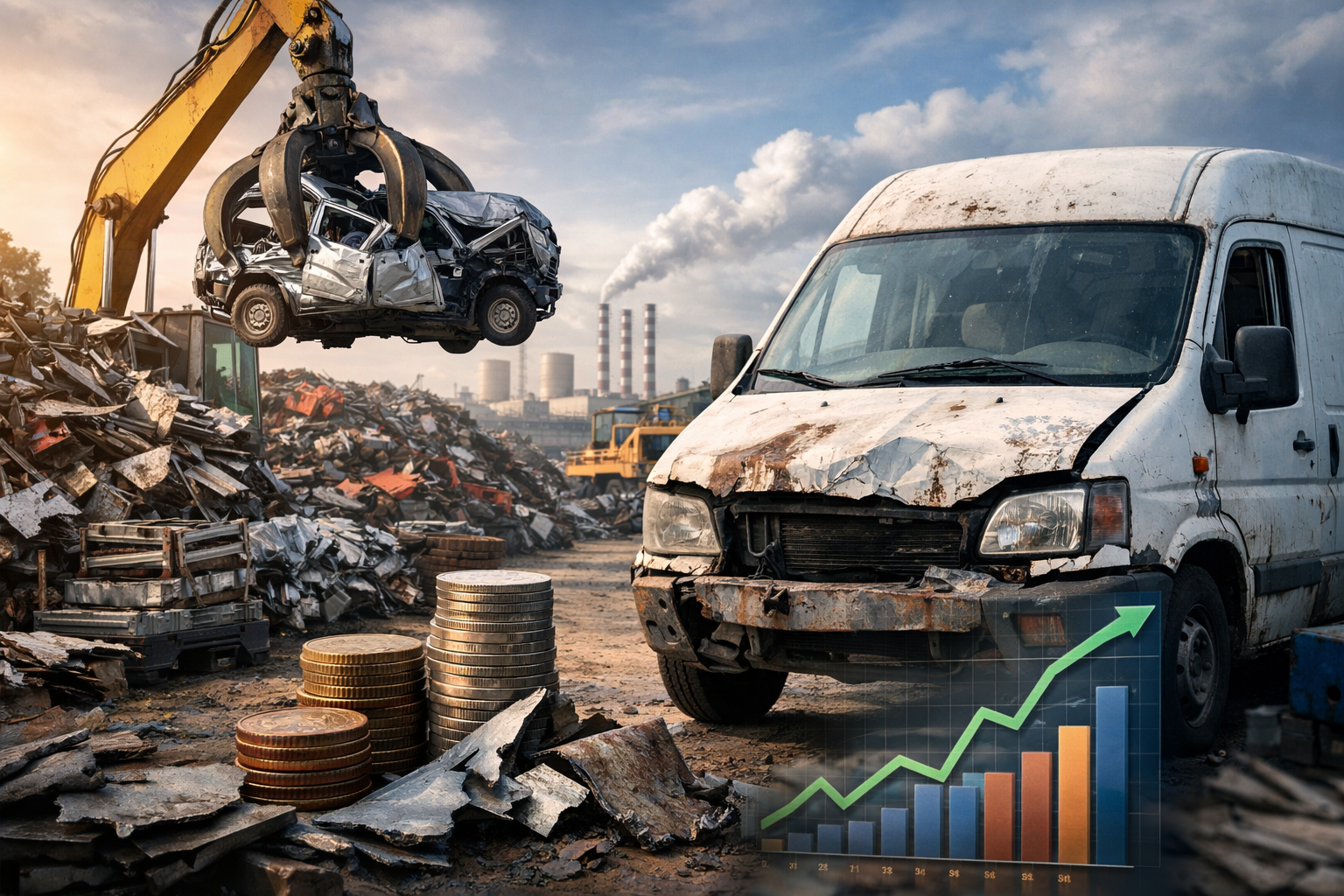
Scrap van prices in the UK are shifting fast in 2025. If you’re sitting on a broken, written-off, or end-of-life van, the amount you’ll be offered today depends on forces most price guides never mention. This article explains exactly what’s driving scrap van prices UK 2025 — and how to make sure you get the best return before the market moves again.
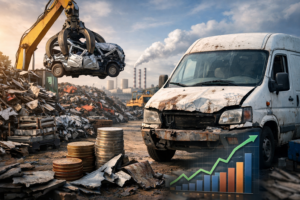
- Steel commodity prices are the single biggest lever on scrap van values — and they’ve been volatile since 2022
- Post-Brexit import duties on new vans have pushed up demand for salvage parts, which can lift your van’s value above basic scrap weight
- The EV transition is quietly reducing catalytic converter demand, affecting prices for older diesel and petrol vans
- Weight, metal composition, and current scrap yard capacity all affect what you’re actually offered
- Getting multiple quotes takes minutes and can add hundreds of pounds to your payout
What Determines the Price of a Scrap Van?
Your van is worth what the metal inside it is worth — plus any usable parts. That’s the short answer.
The longer answer involves three overlapping markets: global steel prices, the UK salvage parts trade, and the specialist metals market for catalytic converters. Each one moves independently. Each one affects your quote.
Steel is the foundation. A typical transit-sized van weighs between 1,200 kg and 2,000 kg. At current scrap metal prices UK yards are paying, that translates to a base value of roughly £150–£350 for the steel alone, depending on the grade and current spot price. When steel demand rises — driven by construction booms or infrastructure spending — scrap prices follow. When demand falls, so does your quote.
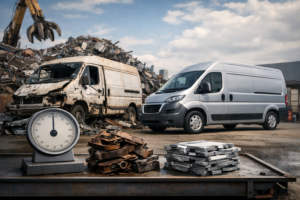
The condition of your van matters, but not in the way most people expect. A van that runs and drives may fetch more through the salvage route. A completely seized, fire-damaged shell is almost pure weight value. The gap between those two outcomes can be £200–£800 on the same make and model.
How Steel Commodity Prices Are Moving in 2025
Steel prices have been on a rollercoaster since 2022. Supply chain disruptions, the war in Ukraine (a major steel-producing region), and fluctuating energy costs in European smelting have all fed into current scrap metal prices UK buyers are working with.
In early 2025, hot-rolled coil steel prices in Europe stabilised after a sharp dip in late 2024. That stabilisation has fed through to slightly firmer scrap yard offers compared to the lows seen in Q3 2024. It’s not a boom — but it’s a better environment than sellers faced six months ago.
Ask your scrap buyer what the current steel price per tonne is. A reputable buyer will tell you. If they won’t, that’s useful information too.
The steel price effect on scrap vans is direct: most yards price ferrous scrap (iron and steel) at a percentage of the current London Metal Exchange benchmark. A £20-per-tonne swing in steel is worth roughly £30–£40 on a large panel van. Small numbers individually — significant if you’re comparing three quotes over a two-week window.
What Post-Brexit Import Duties Have Done to the Van Salvage Market
This is the angle almost every competitor misses entirely.
Since the UK left the EU single market, import duties and supply friction have pushed up the cost of new vans. Ford Transit, Volkswagen Crafter, Mercedes Sprinter — all are now more expensive to bring into the UK than they were pre-2021. Dealers are paying more. Buyers are paying more. And fleet operators are holding vehicles longer.
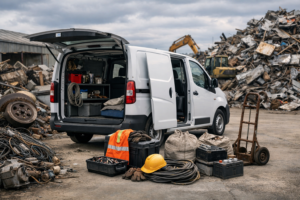
The knock-on effect for the van scrap market 2025: demand for second-hand parts has surged. A working gearbox, a low-mileage engine, or an undamaged body panel from a 2018–2022 van can now command serious money from independent garages and fleet repair shops who can’t get new parts quickly or cheaply.
This means your “scrap” van may not be pure scrap at all. If major mechanical components are intact, a salvage buyer — rather than a basic scrap yard — may offer significantly more. The difference between the two routes can be £300–£700 on a mid-life commercial van.
If you want to understand exactly what your van is worth and get a fast, fair quote, scrapping your van through a specialist buyer who assesses both metal value and salvageable parts is usually the smarter move.
The EV Transition and What It Means for Catalytic Converter Values
Catalytic converters — fitted to petrol and diesel vans to reduce exhaust emissions — contain platinum, palladium, and rhodium. These are precious metals. For years, a van’s catalytic converter added a meaningful premium to its scrap value.
That premium is shrinking, and here’s why.
As electric vans enter the market in volume (Ford E-Transit, Vauxhall Vivaro Electric, Mercedes eSprinter), demand for catalytic converters as replacement parts collapses. Scrap yards and precious metal recyclers are pricing this in. Palladium, which peaked above $2,700 per troy ounce in 2022, had fallen sharply by 2024 as EV adoption accelerated globally.
Some unscrupulous buyers will quote you a price that ignores the cat entirely, then strip it before processing the van. Always ask whether the catalytic converter is included in your quote and get confirmation in writing.
For older diesel vans — particularly pre-2015 models with larger cats — this component can still add £50–£150 to your payout if you’re dealing with a buyer who properly values it.
Scrap vs Salvage: Knowing the Difference
These two words are often used interchangeably. They shouldn’t be.
Scrap means the van is processed for raw material — shredded, melted, recycled. You’re paid by weight, adjusted for metal type. The condition of the van beyond its weight is largely irrelevant.
Salvage means usable parts are removed and resold before the shell is scrapped. The buyer earns more from the van overall, and a good salvage buyer passes some of that margin back to you.
The distinction matters because:
- A van with a working engine but a destroyed body is worth more through salvage
- A van with a seized engine but pristine bodywork is worth more through salvage
- A completely crushed or burned-out shell with no recoverable parts is pure scrap
Knowing which category your van falls into before you call a buyer puts you in a stronger negotiating position.
How to Get the Best Scrap Van Price Right Now
Speed and comparison are your two tools.
Steel prices move weekly. A quote that’s valid today may be lower next week if the market dips — or higher if it rises. Most reputable buyers hold quotes for 24–48 hours. Use that window.
Follow these steps to maximise your return:
Gather your van’s details
Make, model, year, approximate weight, engine type, and current condition. Know whether the engine runs, whether the catalytic converter is present, and whether major body panels are intact.
Get at least three quotes
Contact a mix of local scrap yards and specialist van buyers. Local yards may offer collection, but specialist buyers often pay more because they operate the salvage route as well as scrap.
Ask the right questions
For each quote, ask: Is collection free? Is the catalytic converter included? Is the price guaranteed until collection? Do you handle the DVLA paperwork?
Check the buyer is authorised
Scrap metal dealers in the UK must be registered with their local authority under the Scrap Metal Dealers Act 2013. Ask for their licence number. A legitimate buyer will give it without hesitation.
Confirm everything in writing before handing over the keys
A verbal quote is not a guarantee. Get the agreed price confirmed by email or text before the collection van arrives.
Frequently Asked Questions
How much is a scrap van worth in the UK in 2025?
Most scrap vans in the UK are worth between £150 and £500 for metal value alone, depending on weight and current steel prices. Vans with recoverable parts — working engines, intact gearboxes, good bodywork — can fetch £400–£1,000 or more through the salvage route. The range is wide because steel prices, van size, and condition all vary significantly.
Does the age of my van affect its scrap price?
Age affects scrap price mainly through weight and parts value, not the year on the registration plate itself. A 2008 van in reasonable mechanical condition may fetch more than a 2015 van that’s been in a serious accident. What matters is what’s recoverable and how much it weighs.
Do I need the V5C logbook to scrap my van?
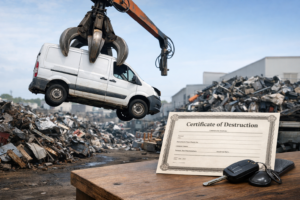
You don’t legally need the V5C to scrap a van, but having it makes the process smoother and confirms you’re the registered keeper. Without it, a reputable buyer will still take the van but may ask for additional proof of ownership. You must notify the DVLA when the van is scrapped — your buyer should handle this, but confirm it before handover.
Will current steel prices go up or down for the rest of 2025?
No one can predict commodity prices with certainty. Analysts in early 2025 expect steel prices to remain broadly stable, supported by infrastructure spending in the UK and EU, but global demand from China remains the wildcard. If you’re ready to scrap, waiting for a price spike is a gamble — the difference is unlikely to be dramatic, and a free collection today has real value.
What happens to my van after it's scrapped?
Authorised treatment facilities (ATFs) — the technical term for licensed scrap processors — drain all fluids, remove the battery and tyres for specialist recycling, strip any recoverable parts, then shred the remaining shell. The steel is baled and sold to steel mills. The UK has strict environmental regulations governing this process under the End of Life Vehicles (ELV) Directive, retained in UK law post-Brexit.
Is it better to sell my van for parts or scrap it?
Selling parts yourself can yield more money in total, but it takes significant time, storage space, and mechanical knowledge. For most van owners, a salvage buyer who handles the whole process offers the best balance of price and convenience. Pure scrap is the right route only when the van has no recoverable value — severely damaged, stripped, or very high mileage with no working components.
The van scrap market in 2025 rewards sellers who understand what they have. Steel prices, salvage demand, and the slow decline of catalytic converter premiums are all in play. Get multiple quotes, ask the right questions, and move when the price is right — not when it’s convenient.
If you’re ready to find out what your van is worth today, getting a quote takes less than two minutes.