
Online quotes beat local scrapyards for most van owners — they’re faster, the price is locked in, and free collection is usually included. But “most” isn’t “all,” and the gap between the two methods is smaller than the internet would have you believe, particularly once you understand how scrap metal pricing actually works and how to time your sale properly.
Summary Comparison: Online Quote vs Local Scrapyard
| Factor | Online Quote | Local Scrapyard |
|---|---|---|
| Speed of quote | ~30 seconds | 8–12 minutes + haggling |
| Price transparency | Live market rate, locked in | Variable, negotiable |
| Collection | Usually free | You arrange (or pay) |
| Availability | 24/7 | Office hours only |
| Paperwork (COD, DVLA) | Handled digitally | Manual, your responsibility |
| Non-runners accepted | Yes, typically | Sometimes, at a discount |
| Price valid for | 24–48 hours | Until you hang up |
| ATF compliance | Vetted by platform | You must verify yourself |
How the Two Methods Actually Work
Online: You enter your registration plate, the system auto-populates make, model and estimated kerb weight from DVLA data, applies current scrap metal commodity prices (primarily steel, with adjustments for aluminium and copper content), and returns an offer — usually in under a minute. You confirm condition, book a collection slot, and wait. The whole thing takes roughly the same amount of time as making a cup of tea, assuming you don’t burn yourself.
Local scrapyard: You call. You wait. Someone answers, eventually. You give them your van’s make, model, year and condition. They disappear to check something. They come back with a number. You push back. They push back. Fifteen minutes later you’ve agreed on a figure that may or may not be what they actually pay when the van arrives and they discover the catalytic converter is missing, the engine is seized, or the fuel tank is “a liability.” This is not a hypothetical sequence of events.
The information each method needs is broadly the same — registration, condition, location — but online platforms use that data to generate a fixed offer, whereas scrapyards use it as an opening position.
Price Comparison: Online Platforms vs Local Scrapyards
Online aggregators pull live scrap metal market data — steel, aluminium, copper — and calculate offers based on your van’s estimated weight and composition. A Transit, for instance, is mostly steel with some aluminium trim; a Sprinter’s diesel engine adds copper wiring value. The prices move daily, sometimes significantly, which is why most online quotes are only valid for 24–48 hours. This is the detail almost nobody mentions, and it matters enormously.
Local scrapyards set prices based on their own overheads, local demand, what they currently have too much of, and how much they think you’ll accept. There is negotiation room built into every number they give you. The question is whether you can find it, and whether the final agreed price beats what you’d have got online without the theatre.
Hidden deductions are where local yards frequently claw back margin. Fuel surcharges for collection (if they offer it at all), condition downgrades on arrival, deductions for missing parts — a catalytic converter alone can knock £50–£150 off a Transit’s value — and “admin fees” that weren’t mentioned on the phone. Online platforms generally lock the price at point of booking, subject only to the condition you declared being accurate.
Real-world price ranges for common vans vary with metal markets, but as a rough guide: a mid-2000s Ford Transit in scrap condition typically returns £150–£350, a Mercedes Sprinter £180–£400, and a Vauxhall Vivaro £120–£280. Both routes operate within these bands; the difference is certainty, not necessarily the ceiling.
A local scrapyard can legitimately beat an online quote when your van has high-value salvageable parts — a low-mileage engine, intact alloys, a working gearbox — that a parts-hungry yard will price separately. Online platforms price on scrap weight, not salvage potential.
Convenience and Speed: A Side-by-Side Breakdown
Online services operate at 3am on a Sunday. Scrapyards do not. That alone solves a surprising number of problems for people whose van dies on a Friday evening.
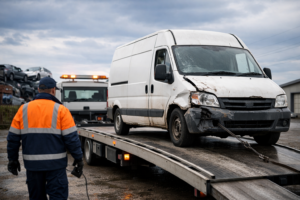
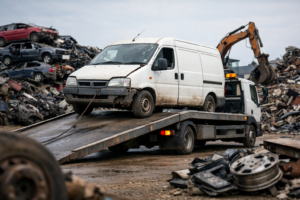
Free collection is standard with most reputable online scrap services — they send an ATF-registered collector to you, load the van (running or not), and handle everything from there. At a local yard, collection, if available at all, is usually charged separately or deducted from your offer. If you can deliver the van yourself, this changes the calculation; if you can’t — because it’s a non-runner, because you live rurally, because you simply don’t have time — the online route wins comprehensively.
Paperwork is where the difference becomes genuinely significant. Your legal obligations when scrapping a van include notifying the DVLA and obtaining a Certificate of Destruction (COD) — the document that confirms the vehicle has been disposed of at an Authorised Treatment Facility. Online platforms handle both digitally. At a local yard, you are responsible for ensuring the COD is issued and the DVLA is notified, and not every yard makes this easy or fast.
Typical timeline: online quote to cash in hand runs 24–72 hours for most services. Local scrapyard, assuming you can get there and they’re not backed up: same day if you deliver, several days if collection is involved.
Trust, Legitimacy and Legal Compliance
An Authorised Treatment Facility (ATF) is a scrapyard or vehicle dismantler licensed by the Environment Agency to legally depollute and destroy end-of-life vehicles. Scrapping a van through an unlicensed collector is illegal — not just for them, but potentially for you, particularly if the vehicle later appears abandoned or is used in another crime.
To verify ATF status, check the Environment Agency’s public register before accepting any quote. Reputable online platforms do this vetting for their entire network, so you don’t have to do it individually for each buyer — which is a genuine time saving when you’re comparing multiple offers.
Red flags when dealing with a local yard: cash-only payment (legal scrap payments must be made by bank transfer or cheque under the Scrap Metal Dealers Act 2013 — cash is illegal), no COD offered, or a collector who turns up in an unmarked van and can’t produce their licence on request. These are not minor administrative quirks; they are indicators of an unlicensed operation.
When to Choose an Online Quote Over Calling a Scrapyard
The online route is the right call when your van is a non-runner or has no MOT — most online services collect these free of charge, no argument. It’s the right call when you want a guaranteed price locked in before collection day, when you need the process done quickly with minimal back-and-forth, or when you want to compare multiple offers simultaneously without spending an afternoon on the phone.
If you want to scrap your van without the hassle of chasing paperwork or arranging transport yourself, the online route handles the entire process from quote to Certificate of Destruction in one place.
Get your instant scrap van valuation from at least two platforms simultaneously — offers can vary by £30–£80 for the same vehicle, and the whole process takes five minutes rather than five phone calls.
When Calling a Scrapyard Might Still Make Sense
If your van has high-value salvageable parts — a working engine with low miles, intact body panels, a full set of alloys — a local yard that operates as a parts dismantler may pay significantly more than any scrap weight calculation. This is the one scenario where the phone call is genuinely worth making first.
If you can deliver the van yourself, you eliminate the collection cost equation entirely, and face-to-face negotiation gives you leverage that an online form does not. Regular trade or fleet operators who scrap multiple vehicles a year often build relationships with a local yard that produce better prices over time than any single online comparison.
Rural locations with limited online collection coverage are a real constraint — not everywhere is served, and it’s worth checking before assuming free collection applies to your postcode.
Questions to ask a scrapyard before agreeing to anything: Are you ATF-registered and can I have your licence number? Will you provide a Certificate of Destruction? Is this your final price or will it be reassessed on arrival? Is payment by bank transfer?
How to Get the Best Price Whichever Route You Choose — Including Timing the Market
Here is the angle that nobody else is telling you, and it is worth real money: scrap metal prices fluctuate monthly, sometimes by 10–15%, driven by global steel and aluminium commodity markets. Online scrap van quotes expire in 24–48 hours precisely because the platforms are exposed to this volatility. A quote you receive today may be £40 higher than one you’d get next week — or £60 lower.
Check the London Metal Exchange or a UK scrap metal price tracker before accepting any offer. If steel prices have risen sharply in the past fortnight, online platforms will reflect this and their quotes will be strong — accept quickly. If prices have dropped, a local yard working off older stock valuations may temporarily offer more. This is how you use the two methods against each other rather than simply picking one.
Always get at least three quotes — mix online platforms and local scrapyards for a true market picture. A scrapyard van price UK comparison only means something if you’re comparing current offers, not prices from six months ago.
Remove personal belongings and tools before collection — not because the collector will steal them (reputable ones won’t), but because you will forget something expensive and feel very silly about it. Understand what affects your van’s scrap value: kerb weight, engine size, completeness (missing catalytic converter, fuel tank, battery all reduce the offer), and whether it’s a common model with established parts demand.
Accepting the first online quote you receive without checking current metal prices is the scrap equivalent of selling a house without checking Rightmove first. It takes three minutes and could be worth £50 or more.
Step-by-Step: Getting Your Online Scrap Van Quote Right Now
Enter your registration plate
The registration lookup auto-populates your van’s make, model, engine size and estimated kerb weight from DVLA records. You don’t need to know how much your Transit weighs — the system does. This is where the instant scrap van valuation process begins.
Confirm condition honestly
Describe the van’s condition accurately — running or non-runner, present or missing parts, damage level. Platforms lock your price based on what you declare; if the collector arrives and finds a condition worse than described, the price will be renegotiated on the spot, usually not in your favour.
Compare returned offers and check ATF credentials
When you get scrap van quotes online from multiple buyers, cross-reference each buyer’s ATF registration against the Environment Agency’s public register. A higher offer from an unlicensed collector is not a better offer — it’s a legal liability.
Book free collection and confirm paperwork
Book your collection slot, confirm the Certificate of Destruction will be issued digitally, and check that the buyer will notify the DVLA on your behalf. If they won’t do both, find one that will.
Prepare for collection day
Clear the van of personal items and tools. Have your V5C logbook ready — most services require it, though some will proceed without one (see FAQ). Payment is processed by bank transfer, typically on the day of collection or within one business day.
- Online quotes are faster, more transparent and include free collection — but they expire in 24–48 hours because they track live metal prices
- Local scrapyards can beat online offers when your van has salvageable parts, but hidden deductions on arrival often erode the headline price
- Timing matters: check steel and aluminium price trends before accepting any offer, and use market peaks to play both routes against each other
- Always verify ATF registration before agreeing to anything — illegal scrapping carries legal consequences for the seller, not just the collector
- Get at least three quotes mixing online platforms and local yards for a genuine market comparison
Our Verdict
For the overwhelming majority of van owners — private sellers, one-off disposals, non-runners, people without the time or transport to visit a yard — the online route is the better choice. The price is locked in, the collection is free, the paperwork is handled, and the whole thing is done in 48 hours. The process of getting a scrap van quote online has genuinely improved to the point where the local scrapyard phone call is no longer the default.
The exception is a van with meaningful salvage value — working engine, useful parts, high-demand model — where a local dismantler’s parts-based pricing will outperform any weight-based online calculation. In that case, call the yard first, then use an online quote as your floor price in the negotiation.
Either way, check the metal markets before you commit. That one step, which takes three minutes and is completely free, is worth more than any comparison article — including this one.
Frequently Asked Questions
Is an online scrap van quote guaranteed, or can the price change on collection day?
Most reputable online platforms lock the price at the point of booking, provided the condition you declared is accurate. If the collector arrives and finds significant discrepancies — missing parts, worse damage than described — the price will be renegotiated. Declare condition honestly upfront and the quoted price holds.
Do online scrap services collect non-running vans for free?
Yes, the majority of established online scrap services include free collection for non-runners. Confirm this explicitly when booking, as coverage can vary by postcode, particularly in rural areas.
How do I know if an online scrap buyer is a legitimate ATF-registered facility?
Ask for their ATF licence number and check it against the Environment Agency’s public register of licensed waste facilities. Reputable platforms vet their entire collector network, but it takes two minutes to verify independently and is worth doing.
Will a local scrapyard pay more than an online quote for my van?
Sometimes — specifically when your van has high-value salvageable parts that a dismantler will price individually rather than by weight. For a standard scrap-condition van, online and local prices are broadly comparable, but local yards are more likely to apply hidden deductions on arrival.
How long does it take to scrap a van using an online service compared to a scrapyard?
Online: quote to cash in hand typically runs 24–72 hours. Local scrapyard: same day if you deliver, several days if collection is arranged. The online route is faster for non-runners and anyone without transport.
Can I scrap a van that still has finance outstanding on it?
No — legally, you cannot scrap a vehicle you do not own outright. If there is outstanding finance, the finance company still has an interest in the vehicle. You must settle the finance before scrapping, or the finance company’s consent is required. A reputable buyer will check for outstanding finance and refuse to proceed if it exists.
What documents do I need to scrap my van legally in the UK?
Your V5C logbook (registration document) is the primary requirement. You’ll also need to ensure a Certificate of Destruction is issued by an ATF and that the DVLA is notified. Most online platforms handle the DVLA notification on your behalf.
Does the time of year affect how much I get for a scrap van?
Yes, indirectly. Scrap metal prices fluctuate with global commodity markets rather than seasons directly, but construction activity — which drives steel demand — does tend to be higher in spring and summer, which can support stronger prices. Monitor current market prices rather than assuming any particular month is best.
What happens to my van after it is scrapped — is it environmentally disposed of?
At an ATF, the van is depolluted first — fluids, fuel, oil, refrigerants and batteries are removed and disposed of according to Environment Agency regulations. The remaining metal is then crushed and sent to a steel mill for recycling. Roughly 85% of a typical van’s material is recycled. Using an unlicensed collector bypasses this process entirely, which is why ATF verification matters.
Can I scrap a van without a logbook (V5C) using an online service?
Some online services will proceed without a V5C, though they may require additional proof of ownership and the process can take longer. You should still notify the DVLA using the V5C’s last section if you have it, or report the missing document to the DVLA separately. Check with your chosen platform before booking — policies vary.
Disclosure: This article may contain affiliate links. If you use a link to obtain a quote or book a service, we may receive a commission at no additional cost to you. This does not influence our recommendations.