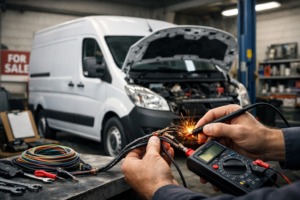
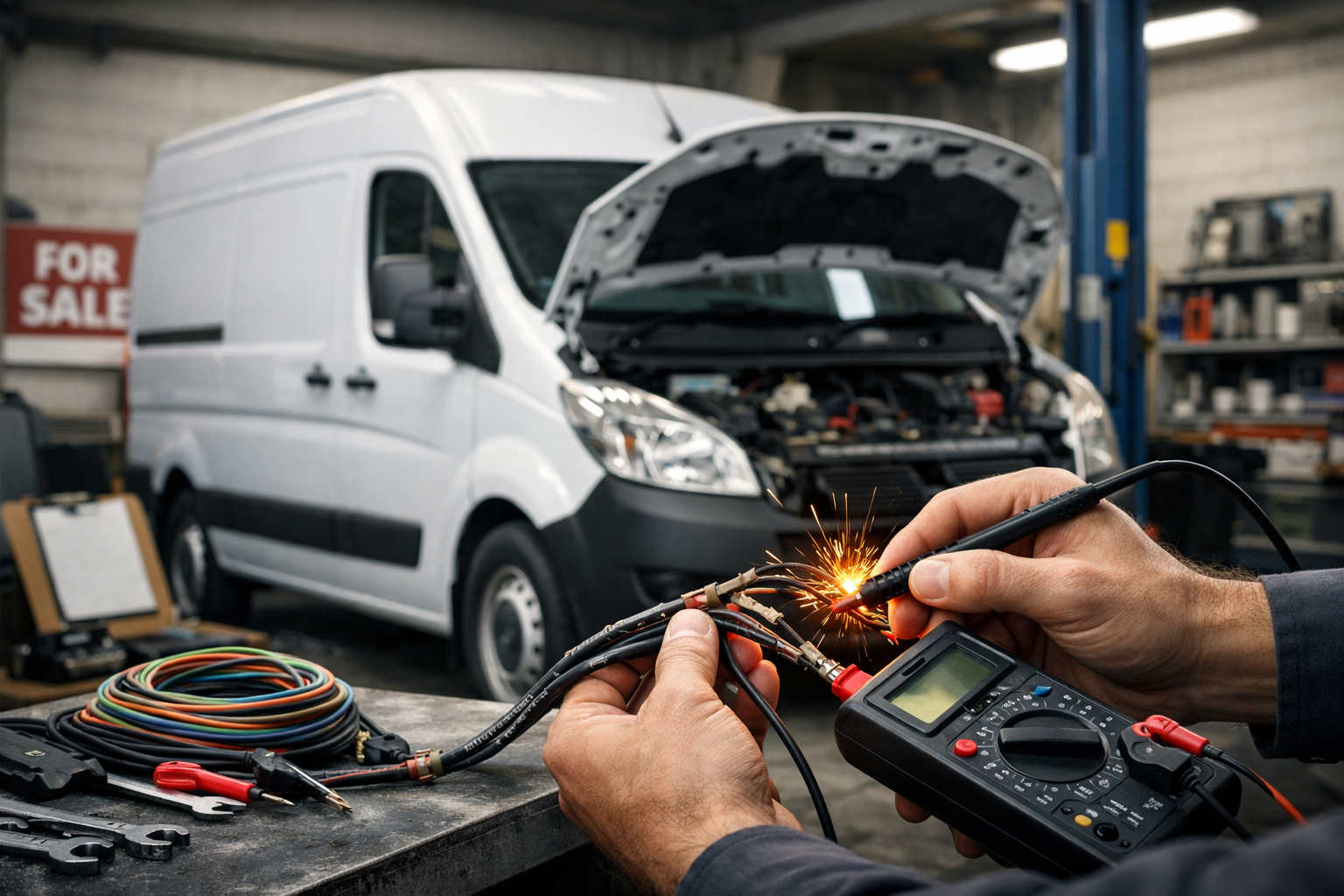
You can sell a van with an electrical fault in the UK — including serious wiring problems — and still receive a fair, cash offer. Specialist buyers purchase vans in any condition, including those with failed electrics, blown fuses, or complex wiring loom faults. You do not need to fix anything first.
What Does “Selling a Van With Wiring or Electrical Faults” Actually Mean?
Selling a van with an electrical fault means putting your vehicle on the market in its current, unrepaired state — where one or more electrical systems are not working correctly. That could be something minor, like a dashboard warning light that won’t clear, or something major, like a complete wiring loom failure that leaves the van undriveable.
The key point: a faulty van is not an unsellable van. The right buyer simply prices the fault into their offer rather than expecting you to fix it first.
Technical Definition
A van’s electrical system is the network of wiring, fuses, relays, control modules, and sensors that power everything from the starter motor to the heating controls. A wiring loom — the bundled cable assembly that carries electrical signals throughout the vehicle — is the backbone of this system.
When any part of this network fails, the symptoms can range from a single non-working component to a van that refuses to start. Faults are categorised broadly as open circuit (a broken connection), short circuit (current flowing where it shouldn’t), or high resistance (a degraded connection that partially works but causes errors).
Electrical faults are not always visible. A van can look perfect on the outside and have a wiring fault that takes a specialist hours to locate.
How It Works — Why Electrical Faults Are So Hard to Price
Think of a van’s wiring loom like the plumbing in a large building. If a pipe bursts in a visible spot, a plumber can quote quickly. But if the leak is buried inside a wall — or if the symptom (damp carpet) is three rooms away from the actual crack — the quote becomes a best guess until the wall is opened.
Electrical faults work the same way. A garage giving you a repair estimate is often quoting for diagnostic time plus a rough guess at parts and labour. That is why quotes for wiring loom faults vary wildly — one garage might quote £400, another £1,800, for the same problem.
Specialist van buyers approach this differently. Rather than quoting to fix the fault, they assess the van’s residual value — its worth as a parts donor, a repair project, or a rebuilt trade vehicle — and make an offer based on that. They carry their own diagnostic knowledge and industry contacts, which means they can price accurately where a standard garage cannot.
Here is how the process typically breaks down:
Describe the fault honestly
Tell the buyer exactly what you know — warning lights, symptoms, any diagnostic codes you have, and what garages have told you. More information leads to a more accurate offer. Vague descriptions can result in a lower initial quote that gets revised on collection.
Receive a valuation
The buyer uses the van’s make, model, age, mileage, and the nature of the electrical fault to calculate an offer. Specialist buyers do this regularly, so they have real-world data on repair costs and salvage values.
Agree the offer and arrange collection
Most specialist buyers collect the van from your address. If the van is undriveable due to the electrical fault, confirm this upfront — reputable buyers will bring a transporter rather than expecting you to drive it.
Get paid
Payment is typically made by bank transfer on the day of collection, or sometimes before. Confirm the payment method before agreeing anything.
Real-World Examples
Example 1 — Complete wiring loom failure. A 2015 Ford Transit develops an intermittent fault that eventually leaves it refusing to start. Three garages give quotes ranging from £650 to £2,200 because nobody can agree on whether the loom needs a partial repair or full replacement. The owner, unable to afford the uncertainty, contacts a specialist buyer. The buyer makes a firm cash offer based on the van’s parts value and drives it away on a transporter. The owner avoids months of diagnostic bills.
Example 2 — Failed ECU causing multiple warning lights. A Vauxhall Vivaro throws every dashboard warning light simultaneously after a water ingress incident. The engine control unit (ECU) — the van’s central computer — has been damaged. Replacement and reprogramming quotes exceed the van’s market value. A specialist van electrical problem buyer offers a price that reflects the van’s recoverable value, and the deal completes in 48 hours.
Example 3 — Recurring short circuit draining the battery. A self-employed plumber’s van keeps killing its battery overnight. He has replaced the battery twice. A garage suspects a short circuit somewhere in the auxiliary wiring added by a previous owner, but cannot find it without extensive diagnostic time. Rather than spending more money chasing the fault, he decides to sell a broken van and use the cash towards a replacement. The process takes less than a day.
Common Misconceptions
Misconception 1: “I need to fix the fault before I can sell.”
You do not. Private buyers may expect a roadworthy van, but specialist buyers purchase vans with wiring loom faults, failed electrics, and everything in between. Fixing a fault before selling often costs more than the repair adds to the sale price.
Misconception 2: “Nobody will want a van with electrical problems.”
There is an active market for vans with electrical faults. Specialist buyers, vehicle dismantlers, and trade repairers all purchase them. A van with a wiring fault still has value in its engine, gearbox, body panels, seats, and dozens of other components. Selling a van with a wiring fault is a well-trodden route.
Misconception 3: “The garage quote is the cost — I should just pay it.”
Not necessarily. Garage quotes for electrical faults carry significant uncertainty because diagnosis is genuinely difficult. A quote is not a fixed price until the fault is fully located. Some owners pay for extensive diagnostics only to receive a repair bill far higher than the original estimate. If the van’s repair cost approaches or exceeds its market value, selling to a specialist van electrical problem buyer is often the smarter financial decision.
Get the van’s OBD fault codes read before you contact a buyer — many motor factors and fast-fit centres do this free of charge. Having the codes in hand gives the buyer more to work with and can result in a stronger offer.
Why It Matters — Practical Relevance If You’re in This Situation Right Now
Electrical faults trap owners in an expensive loop: the van isn’t working, you’re losing income, repair quotes are all over the place, and you don’t know whether to pay up or cut your losses.
Understanding that there is a specialist market for vans in exactly this condition changes the equation. You are not stuck. You have options beyond “fix it or scrap it.”
The wiring loom fault van sell route is particularly useful for self-employed tradespeople who need a quick resolution — waiting weeks for a garage to diagnose a fault while your tools sit in an unusable van is a real business problem. A cash sale to a specialist buyer can fund a replacement vehicle within days.
Avoid any buyer who asks you to pay for a collection vehicle or requests payment from you at any stage. Legitimate specialist buyers pay you — not the other way around.
Summary
- Electrical and wiring faults do not make a van unsellable — specialist buyers purchase them regularly and price the fault into their offer
- Garage quotes for wiring faults vary wildly because diagnosis is genuinely difficult; specialist buyers use residual value and trade knowledge instead
- You do not need to repair anything before selling — attempting to fix a complex electrical fault can cost more than it adds to the sale price
- Having OBD fault codes ready gives buyers more information and can lead to a stronger cash offer
- The process — describe, get a valuation, agree, collect, get paid — is typically completed within 48 hours for most electrical fault cases
Frequently Asked Questions
Will a van with a wiring loom fault pass an MOT?
A van with active electrical faults will almost certainly fail an MOT if those faults affect safety-critical systems such as lighting, ABS, or braking. However, you can legally sell a van without a current MOT — you simply cannot drive it on public roads in that state without one.
Does a van with electrical problems have any value?
Yes. Even a van with a completely failed electrical system retains value in its mechanical components, body panels, and interior. Specialist buyers and dismantlers price vans based on total recoverable value, not just whether they start and drive.
How do I describe the fault to a buyer if I don't know what it is?
Describe the symptoms — what the van does or doesn’t do, which warning lights are showing, when the problem started, and what (if anything) garages have told you. You do not need to know the technical cause. Honest symptom descriptions are enough for a specialist buyer to make an informed offer.
Can I sell a van with electrical problems if it won't start?
Yes. Most specialist buyers can arrange transporter collection for vans that are undriveable. Confirm this when you first make contact so the right vehicle is sent.
Is selling a van with a wiring fault legal in the UK?
Yes, provided you disclose known faults honestly. Selling a vehicle while concealing known defects can constitute misrepresentation. With a specialist buyer, full disclosure is expected and does not reduce your ability to complete the sale — it simply ensures the offer reflects the van’s actual condition.