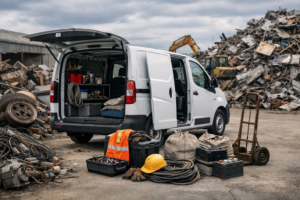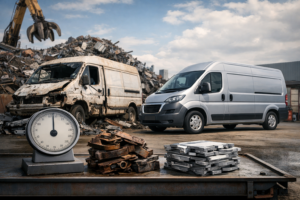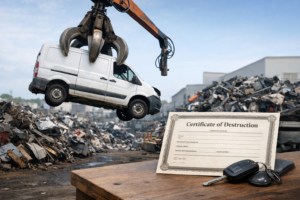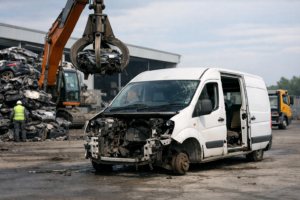
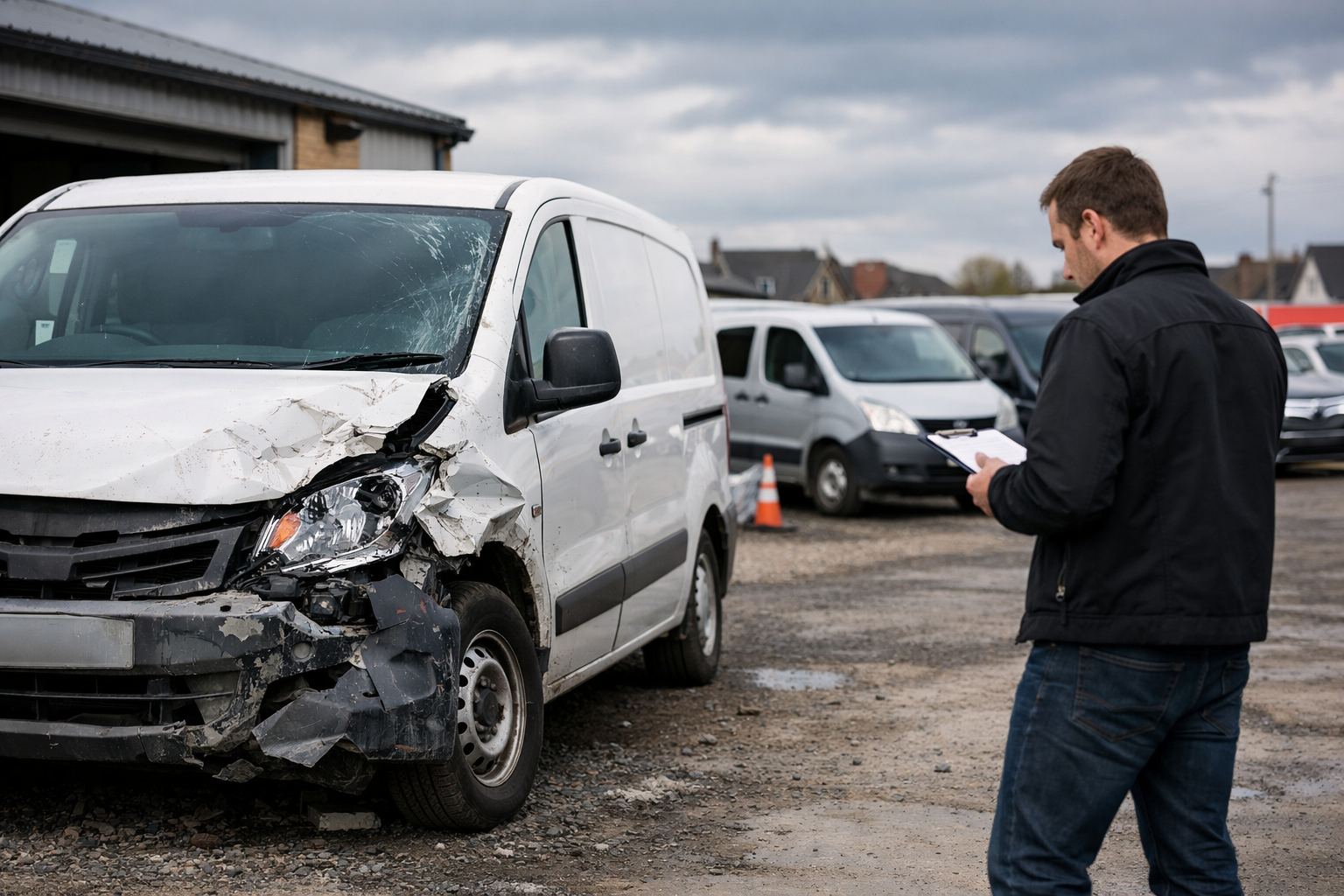
A damaged van is not, as one might reasonably assume after a brief and unfortunate encounter with a motorway barrier, necessarily worthless. It is, in fact, a thing of considerable residual value — provided one knows where to look, what to say, and, crucially, what not to conceal. If you want to sell a damaged van in the UK and receive something approaching a fair price for it, the process is more structured, more legal, and considerably more interesting than simply pushing it into a hedge and walking away.
Key takeaways
- A damaged van — whether cosmetically blemished, mechanically compromised, or formally written off — retains real value, and the amount depends heavily on which category of damage applies
- Disclosure is not optional; failing to declare known damage or a write-off category to a buyer constitutes fraud, which is, as legal problems go, significantly worse than having a dented Transit
- Commercial vans command higher salvage prices than cars, partly because their parts are in perpetual demand and partly because the universe is occasionally fair
- The campervan conversion market — frequently overlooked by sellers — represents a legitimate and often surprisingly lucrative buyer pool for structurally sound but visually damaged panel vans
- Scrapping should be a last resort; selling as spares or repair almost always yields more than scrap weight alone
What Counts as a ‘Damaged Van’ in the UK?
The spectrum of damage, it turns out, is broader than most people appreciate until they are standing in front of a van that has had a complicated relationship with a low bridge. At one end, cosmetic damage — dents, scratches, scuffed bumpers — affects appearance but nothing structural. At the other end, fire and flood damage can compromise a vehicle so thoroughly that its primary remaining virtue is its weight in scrap metal.
Between these poles sit mechanical damage (failed engines, gearboxes, clutches), structural damage to the chassis or body frame, and accident damage — which can be any combination of the above depending on the enthusiasm with which the accident was conducted.
Insurance write-off categories are the formal taxonomy the industry uses to classify this spectrum, and understanding them is essential before attempting to sell:
- Cat A — Crush only. The vehicle must be destroyed in its entirety. It cannot be sold, driven, or parted out. This is the van equivalent of a Viking funeral.
- Cat B — Body shell must be crushed, but parts may be salvaged and sold. The van itself will never see a road again.
- Cat S — Structural damage has occurred (chassis, crumple zones, suspension mountings). The van can return to the road after a professional repair and inspection, but the Cat S marker stays on the vehicle’s history permanently.
- Cat N — Non-structural damage only (cosmetic, mechanical, electrical). Also road-returnable after repair. Generally retains more value than Cat S because buyers perceive structural damage as the more alarming category, which is, on balance, a reasonable position to hold.
Note
A van with no insurance write-off category is simply a damaged van — it may never have been through an insurance claim at all, which is surprisingly common with commercial vehicles whose owners prefer to absorb repair costs rather than lose their no-claims bonus.
Commercial vans — Ford Transit, Mercedes Sprinter, Fiat Ducato, Volkswagen Crafter — tend to carry higher salvage values than equivalent passenger cars. The reason is straightforward: there are a great many of them on the road, their parts are expensive new, and mechanics are consequently extremely interested in acquiring those parts at non-new prices.
Your Options for Selling a Damaged Van in the UK
There are, broadly speaking, five routes available to someone wishing to convert a damaged van into money, each with its own combination of speed, effort, and financial return.
Specialist salvage or damaged-vehicle buyers offer the most efficient transaction. They will assess the van, make an offer, and in many cases collect it. The price will not be the highest theoretically achievable, but the process will be completed before one has time to develop strong feelings about it.
Private sale via online marketplaces — eBay, Facebook Marketplace, Gumtree — offers the highest potential return, because the buyer pool is largest and includes everyone from professional traders to optimistic amateurs. The trade-off is time, negotiation, and a requirement to write an honest listing, which is covered in more detail below.
Part-exchange at a dealership is convenient in the way that accepting whatever is offered without argument is convenient. Dealers have no particular incentive to give generously for a damaged van they did not come to buy.
Scrap yards and breakers are appropriate when the van is beyond economical repair but still contains valuable components — engines, gearboxes, axles, body panels. A breaker will often pay more than a straight scrap merchant, because they are buying the parts, not the weight.
Auction houses — both physical and online platforms such as Manheim or BCA — work well for Cat S and Cat N vans with documented histories. Trade buyers attend specifically to find vehicles like these, and competition between them can produce reasonable results.
The comparison, in brief:
| Route | Speed | Price | Effort | Legal burden on seller |
|---|---|---|---|---|
| Specialist buyer | Fast | Moderate | Low | Low |
| Private sale | Slow | High | High | High |
| Dealership PX | Fast | Low | Low | Low |
| Breaker/scrap | Moderate | Low–moderate | Low | Moderate |
| Auction | Moderate | Variable | Moderate | Moderate |
How to Value Your Damaged Van Accurately
The accurate valuation of a damaged van begins, perhaps counterintuitively, with its undamaged value. Glass’s Guide and CAP HPI are the trade-standard references; live listings on AutoTrader and eBay provide a useful real-world cross-check for what similar vans are actually selling for, as opposed to what people are hopefully asking.
From that baseline, deduct the estimated cost of repair — and here it is strongly advisable to obtain at least two independent quotes from body shops or mechanics, in writing, because buyers will ask and because written quotes carry considerably more authority than a figure one has arrived at through optimism.
The write-off category then applies its own discount. Cat N vans typically retain more of their pre-damage value than Cat S, because structural repair is more expensive, more complex, and more alarming to subsequent buyers. Mileage, age, service history, and make all continue to matter — a low-mileage Ford Transit with a full service history and a dented side panel is a more interesting proposition than a high-mileage, unserviced equivalent with the same dent.
Salvage specialist websites frequently offer free online valuations, which are useful as a floor-price benchmark rather than a ceiling.
Pro tip
High-demand commercial vans — particularly the Ford Transit and Mercedes Sprinter — command meaningfully better salvage prices than obscure or discontinued models. If you own one, this works in your favour; if you own the other kind, it explains a great deal.
Legal Requirements When Selling a Damaged Van in the UK
The legal framework here is not, as some sellers appear to believe, a set of suggestions. Failing to disclose known damage to a buyer can constitute fraud under the Fraud Act 2006 — which is, to be clear, a criminal matter rather than a civil inconvenience.
The specific obligations are as follows:
- Disclose all known damage. Every dent, every category, every mechanical fault you are aware of must be communicated to the buyer before the sale.
- Declare the write-off category. If the van is a registered insurance write-off, the category — Cat S, Cat N, Cat B, or Cat A — must be stated. HPI checks will reveal this regardless, so concealment is both illegal and entirely pointless.
- Notify the DVLA using the V5C logbook. The yellow slip goes to the buyer; the green slip goes to the DVLA. Keep a copy of everything. The DVLA’s online service can also be used to notify the change of keeper.
- Cat A and Cat B vans cannot legally return to the road. They may only be sold for parts or scrapping. Selling a Cat A or B van as a going concern is not a grey area.
- Check for outstanding finance. If the van has finance secured against it, it is not legally yours to sell without settling or transferring that finance first. A HPI check will reveal this; so will the finance company, if asked.
- Issue a bill of sale. A written receipt, signed by both parties, detailing the van’s condition at the point of sale, protects both seller and buyer from subsequent disputes about what was known and when.
Preparing Your Damaged Van for Sale
Preparation, even for a van in genuinely poor condition, is not futile. It is, in fact, the difference between a buyer who arrives expecting one thing and finds another — which produces resentment — and a buyer who arrives knowing exactly what they are getting, which produces a completed transaction.
Gather all documentation: V5C logbook, MOT history (accessible free via the DVLA website using the registration number), service records, and the insurance write-off certificate if one exists. Buyers in the damaged-vehicle market are experienced enough to be suspicious of gaps.
Photograph the van comprehensively and honestly — multiple angles, close-ups of all damage, interior condition, engine bay. Photographs that attempt to flatter a damaged van by careful framing do not deceive experienced buyers; they merely annoy them.
Minor cleaning — removing rubbish, washing the exterior — costs almost nothing and marginally improves the impression the van makes. This is not dishonesty; it is the same logic that applies to tidying a house before viewings.
Warning
Do not attempt to disguise damage with filler, spray paint, or strategic parking. A buyer who discovers concealed damage after purchase has both a legal claim and a legitimate grievance, both of which are expensive and tedious to deal with.
Obtain repair quotes in writing and include them with your listing. They serve two purposes: they help buyers calculate their own numbers, and they demonstrate that you have engaged honestly with the van’s condition.
How to Write a Compelling Listing for a Damaged Van
The title of a damaged-van listing should contain the relevant descriptor — ‘damaged’, ‘Cat N’, ‘Cat S’, ‘spares or repair’ — because buyers searching for damaged vans will use precisely those terms, and buyers not searching for damaged vans will be unhelpfully surprised if they are not warned. Transparency in the title is both an ethical obligation and a practical filtering mechanism.
Lead with the van’s genuine strengths. If the engine runs well, say so first. If the mileage is low, lead with that. If the service history is complete, this is a meaningful selling point even on a broken van — because it tells a buyer that the van was maintained before whatever happened to it happened to it.
Then describe the damage precisely. ‘Accident damage to nearside front, airbags deployed, Cat N write-off, structurally sound, driveable’ is more useful — and more trustworthy — than ‘damaged, sold as seen’. Specific language signals that the seller knows what they are selling and is not attempting to obscure it.
State clearly whether the van is driveable, whether it requires a flatbed for collection, and whether you are open to offers. Price it based on your valuation research, not on what you paid for it or what you wish it were worth.
Who Buys Damaged Vans in the UK and What They Look For
The buyer pool for damaged vans is, on examination, considerably larger and more varied than one might expect. Understanding who is likely to buy your specific van helps you pitch to the right audience through the right channel.
Mechanics and small traders buy damaged vans to repair and resell. They need to see a clear profit margin; their offer will reflect repair cost plus their required margin. A written repair quote helps them calculate this quickly.
Parts breakers are interested in vans where the components are worth more than the whole. A Transit with a seized engine but intact body panels, a working gearbox, and good axles is an interesting proposition for someone who sells parts rather than vehicles.
Small businesses occasionally buy cosmetically damaged vans as working vehicles. A dented side panel does not impede a van’s ability to carry tools, and a van in poor condition that runs reliably is, for certain buyers, exactly the right van at the right price.
Salvage auction buyers and specialist dealers operate in volume and move quickly. They are experienced, unsentimental, and unlikely to pay more than the market supports — but they are also reliable and unlikely to waste one’s time.
Campervan conversion enthusiasts represent a buyer segment that almost no seller thinks to target, and this is, frankly, a significant oversight. The campervan conversion market has grown substantially over the past decade, and conversion builders — whether professional or amateur — frequently seek large panel vans with intact body shells and roofs, regardless of mechanical or cosmetic condition. A Ford Transit or VW Crafter with a sound structure but a failed engine, or with accident damage confined to the front end, is an attractive shell for someone planning to gut the interior entirely and install a kitchen. These buyers will often pay meaningfully more than scrap value, and sometimes more than a breaker would offer, because they are buying the body — which is the expensive part of any conversion. If you have a larger panel van and are wondering whether to sell it to a specialist who buys damaged vans of all types and conditions, it is worth also listing it in campervan conversion forums and Facebook groups, where this specific demand is concentrated.
Avoiding Scams and Getting Paid Safely
The damaged-van market, like any market involving distressed assets and urgent sellers, attracts a proportion of buyers whose interest in the van is secondary to their interest in not paying for it. The following positions are worth maintaining firmly.
Be wary of above-asking offers from buyers who have not viewed the van. This is the opening move of the advance-fee scam, in which the buyer overpays by cheque, asks for the difference to be returned, and the original cheque subsequently bounces. The scam is not subtle, but it is effective enough to persist.
Receive cleared funds before releasing the van. Bank transfer is the safest method. ‘Cleared’ means the money is in your account, not merely promised, pending, or visible in a screenshot.
Do not accept cheques or PayPal Friends and Family payments. Cheques can bounce; PayPal Friends and Family payments offer no buyer protection, which also means no seller recourse if a dispute arises.
Verify the buyer’s identity before handing over the V5C. The logbook is a legal document; handing it to an unverified stranger is inadvisable.
Use a written receipt signed by both parties, detailing the van’s condition at point of sale. This is the document that prevents a buyer from returning three weeks later claiming the van was misrepresented.
Scrapping vs Selling: Which Makes More Financial Sense?
Scrapping is, financially, the option of last resort — which does not mean it is never the right option, only that it should be chosen deliberately rather than by default.
Scrap value is calculated by weight multiplied by the current price per tonne of scrap metal, which fluctuates with commodity markets. The figure is rarely exciting. Selling the same van as ‘spares or repair’ — to a breaker, a private buyer, or through auction — almost always yields more, because buyers are paying for specific components rather than undifferentiated metal.
Scrapping is the correct choice when: the van is a Cat A or Cat B write-off (in which case it is the only legal choice for the vehicle itself); the engine and gearbox are destroyed and the body is too damaged to interest a conversion buyer; or the van has no documentation and no provenance that would support a private sale.
When scrapping, use only an Authorised Treatment Facility — the DVLA maintains a searchable list. An ATF will issue a Certificate of Destruction, which formally removes the vehicle from your name and eliminates any ongoing DVLA or insurance obligations. This is the administrative equivalent of a clean break.
Pro tip
Get quotes from at least three ATFs before committing. Scrap prices vary by region and by the current state of the metal markets, and the difference between the best and worst quote can be meaningful.
Special Scenarios: Flood, Fire, and Stolen-Recovery Vans
These three categories deserve specific mention because they carry complications that standard accident damage does not, and because buyers — particularly experienced ones — will treat them with additional caution.
Flood-damaged vans present a specific challenge: water damage to electrical systems is often invisible at the point of sale and catastrophic months later. Corrosion in wiring looms, control modules, and body cavities can take time to manifest. Experienced buyers know this and will discount heavily; attempting to sell a flood-damaged van without disclosure is both illegal and, given how thoroughly water damage reveals itself over time, ultimately futile.
Fire damage is similarly deceptive. Visible fire damage is alarming; fire damage that has been cleaned up and painted over is more alarming, because the heat may have compromised structural steel, wiring, and fuel lines in ways that are not immediately apparent. Full transparency is the only defensible position.
Stolen-recovery vans — vehicles recovered after theft — may carry a Cat N marker on their HPI record even if they were returned undamaged. The marker reflects the insurance history, not necessarily the vehicle’s condition. These vans can be roadworthy and perfectly usable, but the HPI flag will narrow the buyer pool to those who understand what it means — primarily trade buyers.
In all three scenarios, specialist salvage buyers are typically the most efficient route. They understand these categories, price them accordingly, and do not require the seller to explain why a flood-damaged van is being sold rather than repaired.
Frequently Asked Questions
Can I sell a Cat S or Cat N van privately in the UK?
Yes, both Cat S and Cat N vans can be sold privately. The legal requirement is that you disclose the write-off category clearly to any buyer before the sale completes — in the listing, in conversation, and ideally in writing. A buyer who discovers the category through an HPI check after purchase, having not been told, has grounds for a legal claim. Disclosure is not merely advisable; it is the only lawful approach.
Do I need to tell the DVLA when I sell a damaged van?
Yes. When selling any vehicle — damaged or otherwise — you must notify the DVLA of the change of keeper. The simplest method is to complete Section 6 of the V5C logbook: the yellow ‘sell, transfer or part-exchange your vehicle to a motor trader’ slip goes to the buyer; the remainder of the V5C goes with the buyer; and you notify the DVLA online or by post. Keep a record of the transaction date and the buyer’s details.
How much is my damaged van worth?
The honest answer is: it depends on the make and model, the type and extent of damage, the write-off category if applicable, the mileage, and the current demand for that van’s parts or shell. A Ford Transit with Cat N status and a repairable front-end will be worth considerably more than a high-mileage Sprinter with severe structural damage. Start with the undamaged market value from live listings, deduct repair costs from written quotes, and apply a further discount for the write-off category. Free valuations from salvage specialists provide a useful floor.
Can I sell a van that still has finance on it?
Not legally without resolving the finance first. A van with outstanding finance is technically owned by the finance company, not by the registered keeper. Selling it without settling or transferring the finance is a criminal offence. Contact the finance company to obtain a settlement figure; in some cases, the buyer can arrange to pay the settlement directly as part of the purchase. A HPI check will reveal any outstanding finance, so attempting to sell without disclosing it is both illegal and unlikely to succeed.
What is the fastest way to sell a damaged van in the UK?
A specialist salvage or damaged-vehicle buyer is the fastest route. Many will provide an online valuation within minutes, confirm the offer after a brief inspection, and arrange collection — often within days. The price will not be the maximum theoretically achievable through a patient private sale, but the transaction will be completed without negotiation, viewings, or the particular experience of explaining the van’s history to seventeen successive tyre-kickers.
Is it better to scrap or sell a badly damaged van?
Selling as spares or repair is almost always more financially rewarding than scrapping, unless the van is a Cat A or Cat B write-off — in which case scrapping (via an Authorised Treatment Facility) is the only legal option for the vehicle itself. For everything else, a breaker, a private buyer, or a salvage specialist will typically pay more than the scrap weight value. The exception is a van so comprehensively destroyed that no part of it has identifiable value — which is rarer than one might think, given the demand for commercial van components.
Do I need an MOT to sell a damaged van?
No. There is no legal requirement to have a valid MOT when selling a vehicle privately. However, if the van has a current MOT, this is worth mentioning — it provides useful information about the vehicle’s condition at its last inspection. If the van is being sold as spares or repair and is not roadworthy, the absence of an MOT is expected and unremarkable.
Can a flood-damaged van be repaired and put back on the road?
In principle, yes — but the cost and complexity of properly repairing flood damage to electrical systems, wiring looms, and body cavities frequently exceeds the van’s post-repair value. A van that appears to run normally after drying out may develop electrical faults months later as corrosion progresses. Any buyer intending to repair and use a flood-damaged van should have it assessed by a specialist before purchase; any seller should disclose the flood history fully, as it will appear on an HPI check regardless.
What documents do I need to sell a damaged van in the UK?
The essential documents are: the V5C logbook (without which the sale becomes considerably more complicated for everyone involved); the MOT certificate if current; any service history records; and, if the van is a registered write-off, the insurance write-off certificate. A written bill of sale, signed by both parties and detailing the van’s condition at point of sale, is not legally required but is strongly advisable as protection against subsequent disputes.
Will a salvage buyer collect my damaged van for free?
Many specialist salvage buyers do offer free collection, particularly for vans that are not driveable. This is worth confirming before agreeing a price, as some buyers factor collection costs into their offer rather than quoting them separately. If the van is immobile, confirm the collection method — whether a flatbed is required — and ensure this is accounted for in the agreed terms before signing anything.
If you have a damaged van and want to move it on without the extended theatrical production that private sales can become, the most straightforward step is to get a valuation from a specialist, understand what your specific van is worth in its current condition, and make a decision based on that number rather than on what you paid for it. The van’s history cannot be changed; what can be changed is how efficiently you convert it into money.