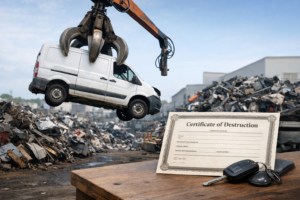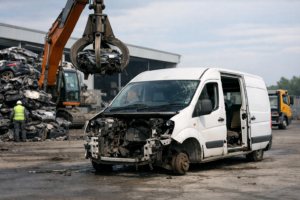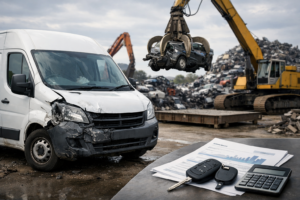
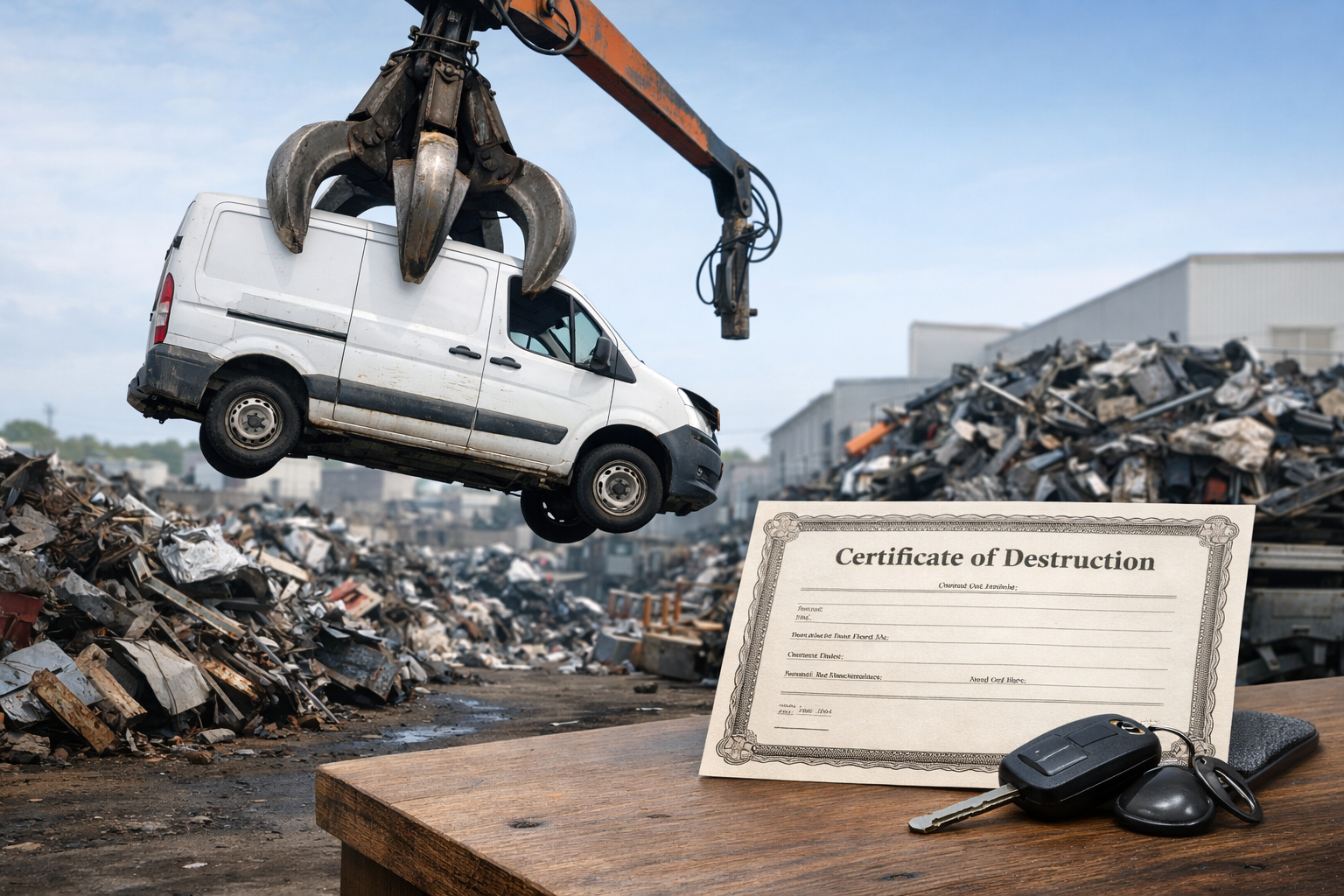
You scrapped your van. You handed over the keys. Job done — right?
Wrong. If you didn’t receive a certificate of destruction van UK law requires from an authorised treatment facility, you are still the registered keeper in DVLA’s eyes. That means parking fines, congestion charges, and even cloned-plate liability can land on your doormat months after you thought the van was gone.
This is the risk almost every competitor article ignores. Here’s what you actually need to know.
- A Certificate of Destruction (CoD) is the only legal proof that your van has been scrapped at an authorised facility
- Without a CoD, you remain the registered keeper and can be held liable for fines and offences committed using the vehicle
- You must also notify the DVLA separately — the CoD alone does not update their records automatically
- Only an Authorised Treatment Facility (ATF) can legally issue a CoD — private buyers and unlicensed scrappers cannot
- Keep your CoD permanently; there is no expiry date but it may be needed years later as legal proof
What Is a Certificate of Destruction?
A Certificate of Destruction — commonly called a CoD — is a legal document issued when a vehicle is scrapped at an Authorised Treatment Facility (ATF). An ATF is a site licensed by the Environment Agency (in England and Wales), the Scottish Environment Protection Agency, or the Northern Ireland Environment Agency to legally depollute and dismantle end-of-life vehicles.
The CoD confirms three things: the vehicle has been received by a licensed facility, it will be destroyed in an environmentally compliant way, and the registered keeper’s legal responsibility for it ends at that point.
A receipt from a scrap dealer, a cash payment, or even a signed agreement is not a Certificate of Destruction. Only an ATF can issue one, and only the ATF-issued document carries legal weight with the DVLA.
Why the CoD Matters More Than Most People Realise
Here is the problem nobody talks about: scrapping a van without a valid CoD leaves you exposed.
Under the Vehicle Excise and Registration Act 1994 and associated regulations, the person recorded as the registered keeper remains legally responsible for the vehicle until the DVLA is formally notified of its destruction. If the van is driven away by a rogue operator, used with cloned plates, or abandoned on a public road, enforcement authorities trace liability back to the last registered keeper — you.
Real consequences include:
- Penalty Charge Notices (PCNs) from local councils
- Congestion charge and Clean Air Zone fines
- DVLA surety letters demanding proof the vehicle was legally disposed of
- In serious cases, involvement in a police investigation if the van was used in an offence
A CoD scrap van transaction — one that ends with a properly issued certificate — closes that liability gap completely.
Who Can Legally Issue a Certificate of Destruction?
Only an Authorised Treatment Facility can issue a CoD. This is not a technicality — it is a requirement under The End-of-Life Vehicles Regulations 2003, which implemented the EU ELV Directive into UK law (retained post-Brexit).
You can verify whether a facility is licensed using the Environment Agency’s public register of permitted waste sites. If a buyer cannot point you to their ATF licence number or registered site address, walk away.
Before handing over your van, ask the operator directly: “What is your ATF permit number?” A legitimate facility will answer immediately. One that hesitates or deflects is a red flag.
Unlicensed operators — sometimes called “cash for scrap” buyers who operate from private yards or lay-bys — cannot issue a CoD. Taking cash from one of these operators and assuming the matter is closed is exactly how registered keepers end up receiving fines for a van they no longer own.
How to Get a Certificate of Destruction for Your Van
The process is straightforward when you use the right facility.
Find a licensed ATF
Search the Environment Agency’s register or use a reputable scrap van service that works exclusively with licensed ATFs. Confirm the facility’s licence before you agree to anything.
Arrange collection or drop-off
Most ATFs offer free collection. You do not need the van to be roadworthy — that is the point. If you want to understand what the full process looks like, the scrap my van service at We Buy Broken Vans outlines exactly what happens from booking through to certificate issue.
Hand over the V5C logbook
Give the ATF the vehicle’s V5C registration document. They need this to process the destruction correctly. Do not send the V5C to the DVLA yourself at this stage — the ATF handles that part of the notification.
Receive your Certificate of Destruction
The ATF is legally required to issue your CoD within seven days of receiving the vehicle. You should receive it by post or electronically. Check that it shows your name, the vehicle registration number, VIN, and the ATF’s details.
Notify the DVLA
This step catches many people out. The ATF notifies the DVLA that the vehicle has been destroyed, but you should also complete the relevant section of your V5C and send it — or use the DVLA’s online service — to confirm you are no longer the keeper. This DVLA scrap notification is separate from the CoD and ensures both records align.
Do not assume the ATF’s notification to the DVLA is sufficient on its own. Complete your own keeper notification to create a clear paper trail on both sides.
What Happens If You Don’t Get a Certificate of Destruction?
Liability does not disappear just because you no longer have the van. Without van scrap legal proof in the form of a CoD, you have no document to present if a fine arrives or if authorities question what happened to the vehicle.
The DVLA can issue a formal enquiry to the last registered keeper. If you cannot produce a CoD, the burden of proving you disposed of the vehicle legally falls entirely on you. Witness statements, text messages, and bank transfer records are not substitutes — they are supporting evidence at best, and insufficient at worst.
Beyond fines, there is an environmental dimension. Unscrupulous operators often strip valuable parts, dump the shell, and leave hazardous fluids — oil, coolant, battery acid — to leach into the ground. The registered keeper who handed the van over can face questions about facilitating illegal waste disposal.
How Long Should You Keep Your Certificate of Destruction?
Keep it permanently. There is no statutory limitation period that makes a CoD irrelevant, and DVLA records occasionally contain errors that surface years later. A CoD from five years ago can resolve a dispute in minutes. Without it, the same dispute can take weeks of correspondence.
Store a digital copy in cloud storage and keep the original in a safe place with other vehicle documents.
Frequently Asked Questions
How long does it take to receive a Certificate of Destruction?
An ATF is legally required to issue your CoD within seven days of taking the vehicle. In practice, many facilities issue it faster — sometimes within 24 to 48 hours. If you have not received it after ten days, contact the facility directly and request confirmation.
Can I scrap my van without the V5C logbook?
You can, but it complicates the process. Without a V5C, the ATF may require additional identity verification, and the DVLA scrap notification becomes more involved. Contact the DVLA to report the V5C as lost before scrapping, so there is a clear record of your ownership and the subsequent destruction.
Does a Certificate of Destruction cancel my van's road tax automatically?
No. Road tax (Vehicle Excise Duty) is not cancelled automatically by a CoD. You need to notify the DVLA separately that the vehicle has been scrapped. The DVLA will then issue a refund for any complete months of remaining tax. The CoD is proof of destruction; the keeper notification triggers the tax cancellation.
What is the difference between a CoD and a receipt from a scrap dealer?
A receipt is a private document between two parties. A Certificate of Destruction is a statutory document issued under The End-of-Life Vehicles Regulations 2003 by a licensed ATF. Only the CoD has legal standing with the DVLA and enforcement authorities. A receipt proves you were paid — it does not prove the van was legally destroyed.
Can I get a duplicate CoD if I lose the original?
Yes. Contact the ATF that issued it — they are required to keep records and can reissue a copy. If the ATF has closed, contact the Environment Agency, which holds records of permitted sites and their destruction certificates.
What if the company I sold my van to cannot provide a CoD?
Stop. Do not complete the transaction. If a buyer cannot issue a CoD, they are not an ATF, and you will remain liable as the registered keeper. Retrieve the vehicle if possible, report the operator to the Environment Agency, and find a licensed ATF instead.
If you are ready to scrap your van the right way — with a Certificate of Destruction issued the same day and full DVLA notification handled for you — get in touch with a licensed operator before you agree to anything else. One document protects you. Make sure you get it.