When you hand over a van to be scrapped, the story doesn’t end there — for you or the vehicle. An authorised treatment facility (ATF) is a licensed site that legally depollutes and dismantles end-of-life vehicles, issuing you a Certificate of Destruction that removes your name from the vehicle’s registered ownership. Without one, you remain legally responsible for that van.
What Is an Authorised Treatment Facility — and Why Does It Matter for Van Scrapping?
An authorised treatment facility (ATF) is a government-licensed site permitted to accept, depollute, and dismantle end-of-life vehicles in compliance with UK environmental law. Every van scrapped legally in the UK must pass through one. If your van goes anywhere else, you have no legal protection — and no proof the vehicle is off your hands.
Think of an ATF like a hospital operating theatre. Just as a surgeon must be licensed, work in a regulated environment, and follow strict protocols before performing an operation, an ATF must hold the correct environmental permits, follow defined depollution steps, and record everything. A backstreet scrapper is the equivalent of surgery in a garden shed — it might get the job done, but the risks are entirely yours.
Technical Definition
Under the End-of-Life Vehicles (ELV) Regulations 2003 — the UK legislation that implemented the EU ELV Directive — only an ATF can legally accept and process an end-of-life vehicle. ATFs are regulated by the Environment Agency in England, Natural Resources Wales, or SEPA in Scotland, and must hold a valid environmental permit or waste management licence.
The facility is required to meet strict standards covering site drainage, impermeable surfaces, fluid containment systems, and waste storage. These aren’t optional extras — they are minimum legal requirements that protect soil, groundwater, and the surrounding environment from hazardous vehicle fluids.
You can check whether a scrap site is a genuine ATF by searching the Environment Agency’s public register of licensed waste operators before you hand over your van.
How the Legal Van Scrapping Process Works
The ATF process follows a defined sequence. Understanding each stage tells you exactly what is happening to your van — and why each step protects you.
Vehicle acceptance and identity check
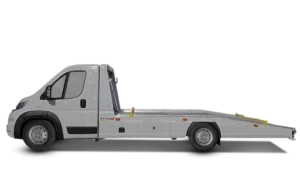
When your van arrives at an ATF, staff record its registration number, VIN (Vehicle Identification Number), and your details as the registered keeper. This creates an auditable trail. The ATF is legally required to notify the DVLA that the vehicle has been received for destruction.
Fluid removal and depollution
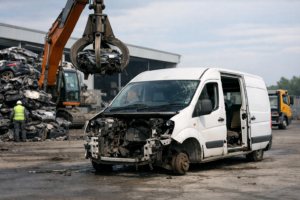
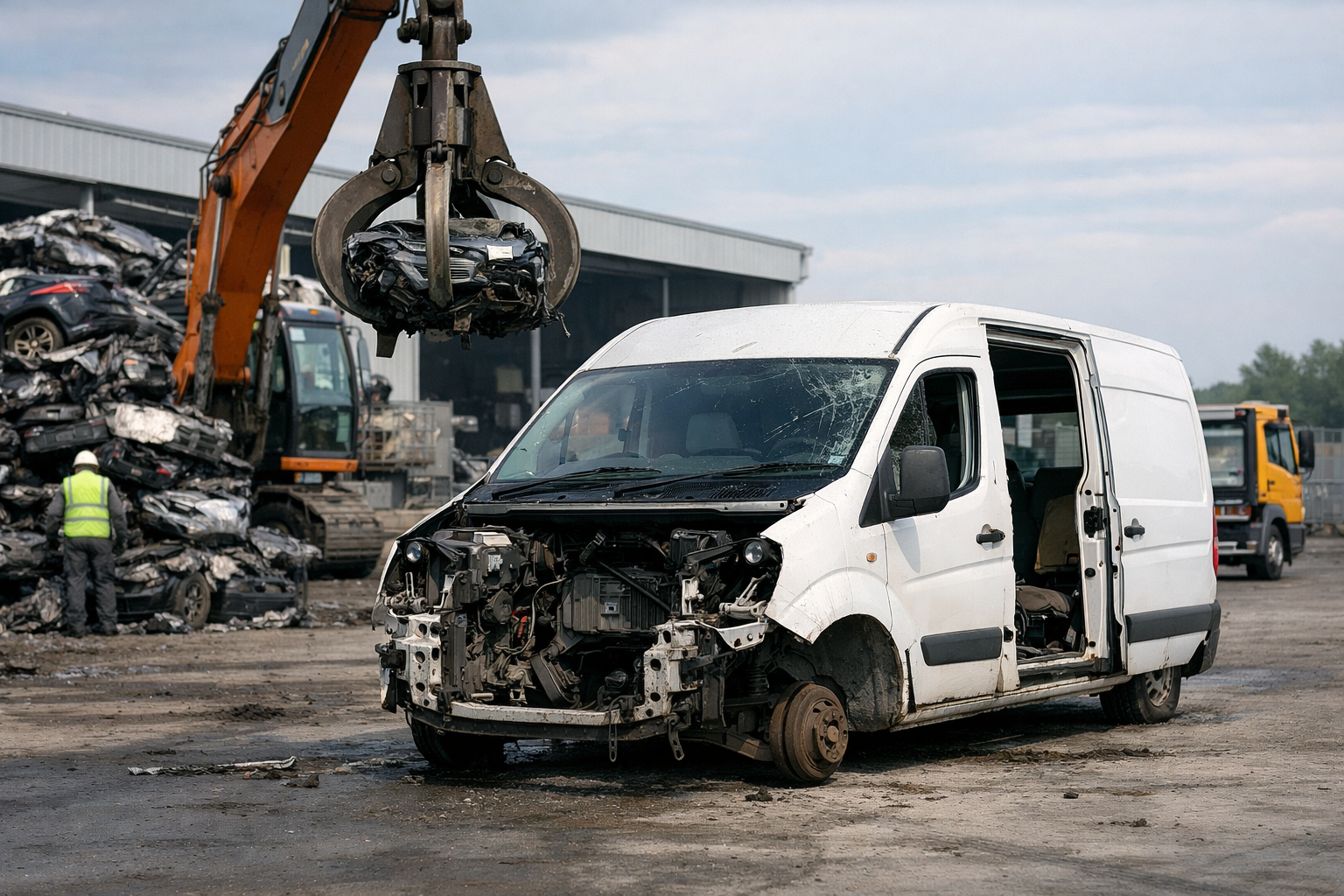
This is the most environmentally critical stage. Before anything is dismantled, trained operatives drain and safely contain every hazardous fluid — engine oil, coolant, brake fluid, power steering fluid, fuel, and windscreen washer concentrate. Airbag pyrotechnic charges and seatbelt pre-tensioners are also safely neutralised at this stage.
Think of it like emptying a petrol can before you crush it. You wouldn’t throw a full can into a compactor — the same logic applies to a van carrying litres of toxic fluids.
Parts salvage
Once depolluted, the van is assessed for reusable parts. Tyres, batteries, catalytic converters, alternators, gearboxes — anything with a second life is removed and either resold or sent for specialist recycling. This is where much of the commercial value in scrapping is recovered, which is why reputable ATF-based buyers can still offer you a fair price.
If you want to scrap your van through a fully compliant ATF process, using a specialist buyer who works exclusively with licensed facilities is the simplest way to guarantee every step is handled correctly.
Shredding and material recovery
The depolluted, stripped shell is then crushed and shredded. The resulting material — a mix of steel, aluminium, copper, and plastics — is separated and sent to commodity recyclers. Steel goes back into the production chain. This is why scrapping a van is genuinely circular: the raw materials re-enter manufacturing rather than going to landfill.
Certificate of Destruction issuance
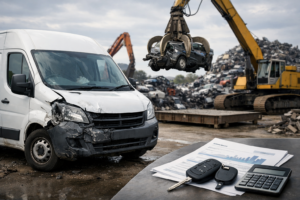
This is the step most van sellers never hear about — and the one that matters most to them legally. Once the vehicle is processed, the ATF issues a Certificate of Destruction (CoD). This document is submitted to the DVLA, formally removing the vehicle from your name. From that point, you have no liability for road tax, insurance, parking fines, or any other obligation connected to that van.
If you scrap a van with an unlicensed buyer who cannot issue a CoD, the vehicle stays registered in your name. Any future misuse — including the van being driven illegally or abandoned — can come back to you.
Real-World Examples
Example 1 — The sole trader with a written-off van. A plumber’s Transit is declared a total loss after a collision. The insurance company arranges collection, but the plumber assumes that’s the end of it. Six months later, a parking fine arrives. The van was sold to an unlicensed scrapper who resold it rather than destroying it. A CoD from an ATF would have closed that loop immediately.
Example 2 — The fleet manager clearing old stock. A logistics company retires five vans in one quarter. By using an ATF-registered buyer, each van generates a CoD that is logged against the fleet record. The company’s DVLA correspondence drops to zero, and there is a clear paper trail for their environmental compliance reporting.
Example 3 — The private seller who shops on price alone. A van owner searches “ATF van disposal UK” and finds two quotes — one from an ATF-registered buyer, one from a cash buyer with no paperwork. The cash buyer offers £40 more. The seller takes it. Three months later, the van is found abandoned and the seller receives a council enforcement letter. The £40 saving cost considerably more to resolve.
Common Misconceptions About Scrapping a Van
Misconception 1: “Selling it to a scrapyard means it’s sorted.”
Not all scrapyards are ATFs. A scrapyard is a general term — it might be a legitimate ATF, or it might be an unlicensed dealer. The only thing that confirms legal compliance is the ATF’s environmental permit number and the subsequent CoD. Always ask for both before you hand over the keys.
Misconception 2: “I notified the DVLA, so I’m covered.”
Telling the DVLA you’ve sold a vehicle is not the same as a Certificate of Destruction. A sold notification transfers ownership; a CoD terminates the vehicle’s legal existence. Until a CoD is issued, the van is still technically a registered vehicle — and someone could re-register it.
Misconception 3: “The scrapper handles everything — I don’t need to check.”
This is the most dangerous assumption. Reputable ATF-based buyers do handle everything, but you should still receive — and keep — a copy of your CoD. It is your proof. If a dispute ever arises, that document is your defence.
Why This Matters for You Practically
The legal van scrapping process exists to protect three things: the environment, public safety, and you as the registered keeper. The depollution steps prevent toxic fluids from entering groundwater. The parts salvage process reduces the demand for new raw materials. And the CoD severs your legal connection to the vehicle permanently.
For a beginner scrapping a van for the first time, the key insight is this: the process is not just about getting rid of metal. It is about correctly exiting a legal relationship with a registered vehicle. An ATF, and the certificate of destruction it issues, is the mechanism that makes that exit clean and final.
Choosing an authorised treatment facility isn’t a bureaucratic nicety. It is the only route that genuinely protects you.
Summary
- An ATF (authorised treatment facility) is the only type of site legally permitted to process end-of-life vans in the UK under the ELV Regulations 2003.
- The legal van scrapping process involves five stages: vehicle acceptance, fluid depollution, parts salvage, shredding, and Certificate of Destruction issuance.
- A Certificate of Destruction (CoD) is the document that formally removes a van from your name at the DVLA — without it, your legal liability continues.
- Not every scrapyard is an ATF — always verify an environmental permit number before handing over your vehicle.
- Price alone is a poor guide: an unlicensed buyer who offers more money but cannot issue a CoD can leave you exposed to fines, enforcement letters, and ongoing liability.
Frequently Asked Questions
How do I get a Certificate of Destruction for my van?
The ATF that processes your van issues the CoD directly to the DVLA on your behalf. You should also receive a copy for your own records. If a buyer cannot confirm they will provide a CoD, they are not operating as a licensed ATF — do not use them.
Is the ATF van disposal process free?
It depends on the van’s age, condition, and current scrap metal prices. Many ATF-registered buyers will collect and process your van at no charge, and some will pay you for it. The value of the scrap metal often offsets the processing cost entirely.
How long does the legal van scrapping process take?
From collection to CoD, the process typically takes between seven and fourteen days, depending on how quickly the ATF processes the vehicle and notifies the DVLA. You should receive confirmation once the CoD has been issued.
Can I scrap a van that isn't in my name?
No. You must be the registered keeper, or have written authority from the registered keeper, to legally surrender a vehicle for scrapping. The ATF is required to verify ownership before accepting the vehicle.