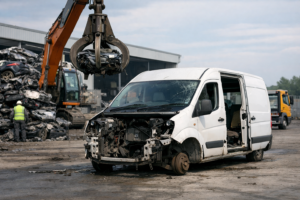

Scrapping a van or part-exchanging it at a dealer: which puts more money in your pocket? For most owners of non-running, high-mileage, or damaged vans, scrapping wins — often by a significant margin. Dealers routinely decline vans in poor condition outright, and when they do accept one, the “condition adjustment” they apply is rarely explained in plain numbers. This comparison gives you those numbers, so you can decide with confidence.
Affiliate disclosure: This article contains no affiliate links. All opinions are independent.
Quick comparison: scrap van vs dealer part exchange
| Criteria | Scrap / Buy-Any-Condition | Dealer Part-Exchange |
|---|---|---|
| Accepts non-running vans | ✅ Yes | ❌ Rarely |
| Accepts high-mileage vans | ✅ Yes | ⚠️ Sometimes, with heavy deductions |
| Price transparency | ✅ Fixed quote upfront | ❌ Condition adjustments often opaque |
| Speed of payment | ✅ Same day in most cases | ⚠️ Tied to your next vehicle purchase |
| Cash in hand | ✅ Direct payment | ❌ Discount off new vehicle only |
| Best for | Unwanted, damaged, or end-of-life vans | Roadworthy vans with moderate mileage |
What is dealer part exchange?
Dealer part exchange — often called a “trade-in” — means handing your current van to a dealership as part-payment toward a replacement vehicle. The dealer values your van, deducts that figure from the purchase price of the new one, and you pay the difference.
It sounds straightforward. In practice, the valuation process is far less transparent than it appears. Dealers use your van’s value as a negotiating lever, not as a fixed, independent figure. The “price” they offer you is often inseparable from the margin they are making on the vehicle you are buying.
If you are not buying a replacement van, dealer part exchange is not available to you at all. You need to be purchasing something from that dealer to use their trade-in scheme.
Option 1: Scrapping or selling to a buy-any-condition buyer
Overview
Scrapping a van — or selling it to a specialist buyer who accepts vans regardless of condition — means receiving a direct cash payment for your vehicle, with no obligation to buy anything else. The buyer collects the van, handles the DVLA paperwork, and pays you on the same day in most cases.
This is the primary route for part exchange broken van UK owners explore when dealers turn them away. It is also the best option for unwanted vans that have sat unused, failed an MOT, or been involved in an accident.
Key strengths
- Accepts any condition. Non-running, flood-damaged, high-mileage, or failed MOT — a specialist buyer will still make an offer.
- Transparent pricing. You receive a fixed quote before committing. No condition adjustments revealed at the last minute.
- No purchase obligation. You do not need to buy a replacement vehicle to release the value tied up in your old one.
- Fast. Collection and payment typically happen within 24–48 hours of accepting a quote.
Weaknesses
- If your van is in genuinely good condition and you are buying a replacement, you may achieve a slightly higher effective value through a dealer trade-in — though this is not guaranteed.
- The cash value of a scrap or end-of-life van is lower in absolute terms than a roadworthy one. That is a function of the van’s condition, not the process.
Who is it best for?
Owners of non-running, damaged, or high-mileage vans. Anyone who wants to sell without buying a replacement. Anyone who has already been turned away by a dealer or received a derisory offer.
If you want to understand exactly what your van could fetch through this route, the scrap my van valuation process explains how quotes are calculated based on weight, make, and current metal prices — with no obligation to proceed.
Option 2: Dealer part exchange
Overview
A dealer part exchange works by offsetting your van’s trade value against the cost of a new purchase. In theory, this is convenient — one transaction, one visit. In practice, the dealer controls both sides of the equation.
The trade-in value they quote is not independently verified. It reflects what the dealer believes they can resell your van for, minus their margin, minus a “condition adjustment” that is rarely itemised. Industry practice puts typical condition deductions at anywhere from £500 to several thousand pounds for vans with cosmetic damage, high mileage, or service history gaps — but dealers are not required to show you the workings.
Key strengths
- Convenient if you are already buying a replacement van from the same dealer.
- Can be tax-efficient for VAT-registered businesses (consult your accountant on this point, as individual circumstances vary).
- Removes the hassle of selling privately.
Weaknesses
- Dealers rarely accept non-running vans at all. If your van does not drive onto their forecourt, most dealers will decline it outright or offer a nominal figure.
- Condition adjustments are opaque. A dealer might quote £4,000 for your van, then reduce it to £2,200 on the day because of “bodywork” or “tyre wear” — deductions that were never quantified upfront.
- The value is tied to a purchase. You cannot take the trade-in value as cash and walk away. The money only exists as a discount on your next vehicle.
- High-mileage vans attract heavy penalties. Vans above 150,000 miles are routinely devalued by 30–50% versus a comparable lower-mileage example, with no transparent formula applied.
Who is it best for?
Owners of roadworthy, relatively low-mileage vans who are already committed to buying a replacement from a franchised dealer. If both conditions apply, a part exchange can be genuinely convenient.
Never accept a dealer’s first trade-in figure without getting at least one independent quote first. The dealer trade-in vs scrap comparison almost always favours scrapping once a van has significant condition issues — and getting a scrap quote costs you nothing.
Head-to-head comparison by key criteria
Which option pays more for a non-running van?
Scrapping pays more — because a dealer will typically offer nothing at all. A non-running van has zero part-exchange value at most franchised dealers. A specialist scrap or buy-any-condition buyer will still pay based on weight and salvageable parts, which for a typical panel van can range from a few hundred to over a thousand pounds depending on the make and current metal prices.
Which option is more transparent on price?
Scrapping is more transparent. A reputable buyer gives you a fixed quote before collection. Dealer part exchange involves a valuation that can change on the day — and the adjustment is rarely explained line by line.
Which option is faster?
Scrapping is faster. Most specialist buyers collect within 24–48 hours and pay on the same day. A dealer part exchange is tied to the timeline of your new vehicle purchase, which can take days or weeks.
Which option suits a high-mileage van?
Scrapping suits high-mileage vans better. Dealers apply steep deductions for mileage above roughly 100,000–150,000 miles. A scrap buyer values the van on its physical weight and parts, not its odometer reading.
Which option gives you actual cash?
Scrapping gives you cash. A dealer trade-in gives you a discount — which only has value if you were going to buy that vehicle at that price anyway.
Our Verdict
For vans in poor condition — non-running, high-mileage, damaged, or simply unwanted — scrapping or selling to a buy-any-condition buyer is the clear winner. The comparison is not close.
Dealer part exchange is built for a specific scenario: a roadworthy van, a buyer who is already committed to a new purchase from that dealer, and a seller who values convenience over maximum return. Outside that scenario, the opaque condition adjustments, the refusal to accept non-runners, and the lack of a cash payment make it a poor fit.
The best option for unwanted vans — particularly those that have been declined by dealers or have obvious condition issues — is a specialist buyer who will give you a fixed quote, collect for free, and pay on the same day.
Before you commit to any route, get a scrap or buy-any-condition quote first. It is free, it takes minutes, and it gives you a genuine baseline. If a dealer then beats it, you can take the dealer’s offer. If they do not, you have lost nothing by checking.
- Dealers rarely accept non-running or heavily damaged vans — scrapping is often the only realistic option for these vehicles
- Dealer condition adjustments can reduce a trade-in offer by hundreds to thousands of pounds, with no transparent breakdown
- Scrap and buy-any-condition buyers offer fixed quotes, free collection, and same-day payment
- High-mileage vans (above 100,000–150,000 miles) face steep dealer deductions; scrap buyers value on weight and parts instead
- Always get a scrap quote before committing to a part exchange — it costs nothing and gives you a real comparison point
Frequently Asked Questions
Can I part exchange a broken van at a dealer?
In most cases, no. Franchised dealers require a van to be roadworthy and driveable to accept it as a trade-in. If your van does not run, the dealer will typically decline it or offer a nominal figure that does not reflect its true scrap value. A specialist buy-any-condition buyer is the practical alternative.
How much less will a dealer offer compared to a scrap buyer for a damaged van?
There is no single figure, but the gap can be substantial. For a non-running van, a dealer may offer nothing at all, while a scrap buyer might pay several hundred pounds. For a running but damaged van, dealer condition adjustments of £500–£2,000 are common — and those adjustments are rarely itemised upfront.
Is dealer trade-in vs scrap ever worth it for the van owner?
Yes — in a specific scenario. If your van is roadworthy, under 100,000 miles, and you are already buying a replacement from that dealer, a part exchange can be convenient and competitive. Outside that scenario, scrapping or selling to a specialist buyer almost always returns more value.
What happens to my van after it is scrapped?
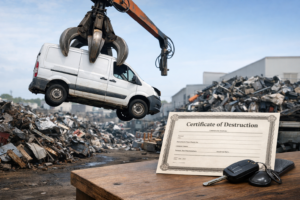
A reputable buyer will issue you a Certificate of Destruction (CoD), which notifies the DVLA that the vehicle has been scrapped. This removes your liability for the vehicle. Parts that can be reused are salvaged; the remaining metal is recycled. You should never scrap a van without receiving a CoD.
Do I need a V5C logbook to scrap my van?
You do not strictly need a V5C to scrap a van, but having it makes the process smoother and can affect the offer you receive. If you have lost your logbook, a reputable buyer will still be able to process the vehicle — they will advise you on the DVLA notification steps required.
How quickly can I get paid when scrapping a van?
Most specialist buyers pay on the day of collection, either by bank transfer or in some cases by cash. The entire process from quote to payment typically takes 24–48 hours once you have accepted an offer.