Yes, a non-running van can absolutely be collected for scrap in the UK. The whole point of specialist scrap van collection is that the vehicle doesn’t need to go anywhere under its own steam — a flatbed truck and a winch will do that job far more competently than your van ever did in its final weeks.
- A non-running van can be collected for scrap anywhere in the UK using flatbed and winch-recovery vehicles — you do not need to get it started, moved, or even pushed to the kerb
- Scrap van collectors will come to private land, driveways, garages, and industrial units — though access matters enormously and you should mention it upfront
- The price for a non-runner is calculated on weight and metal content, not on whether the engine runs, so you won’t be penalised as heavily as you might expect
- You’ll still need a valid V5C (or at least the reference number) and the collector must issue an official Certificate of Destruction
- Book the collection yourself — don’t let the van sit there quietly rusting while you “get round to it”, because scrap metal prices move and waiting rarely helps
Why a Dead Van Is Still Worth Something
Here’s the thing about your completely deceased, won’t-start-on-a-cold-morning-or-any-other-morning van: it is still, fundamentally, a large pile of steel, aluminium, copper wiring, and various other metals that someone with a crusher and a set of scales will pay you actual money for.
The scrap value of a van is calculated almost entirely on weight and metal composition — not on whether the thing runs, drives, or even has all four wheels pointing in the same direction. A Transit that hasn’t started since the last government is worth essentially the same per tonne as one that drove in under its own power. The engine being dead doesn’t vaporise the steel.
The current scrap metal market fluctuates, but a full-size panel van typically yields somewhere between 1.5 and 2.5 tonnes of scrap metal. At prevailing rates, that’s a meaningful sum of money that is currently just sitting on your driveway doing absolutely nothing except annoying your neighbours and slowly merging with the tarmac.
How Scrap Non Running Van Collection UK Actually Works
Most people assume that “collection” means a man turns up in a car transporter, you hand over the keys, and the van rolls gracefully up the ramp. This is not what happens with a non-runner, and anyone who has tried to push a Transit up a ramp alone will confirm that it is not a graceful experience.
Legitimate scrap van collectors use one of two methods for vehicles that cannot move under their own power:
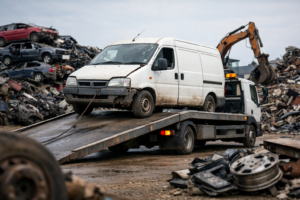
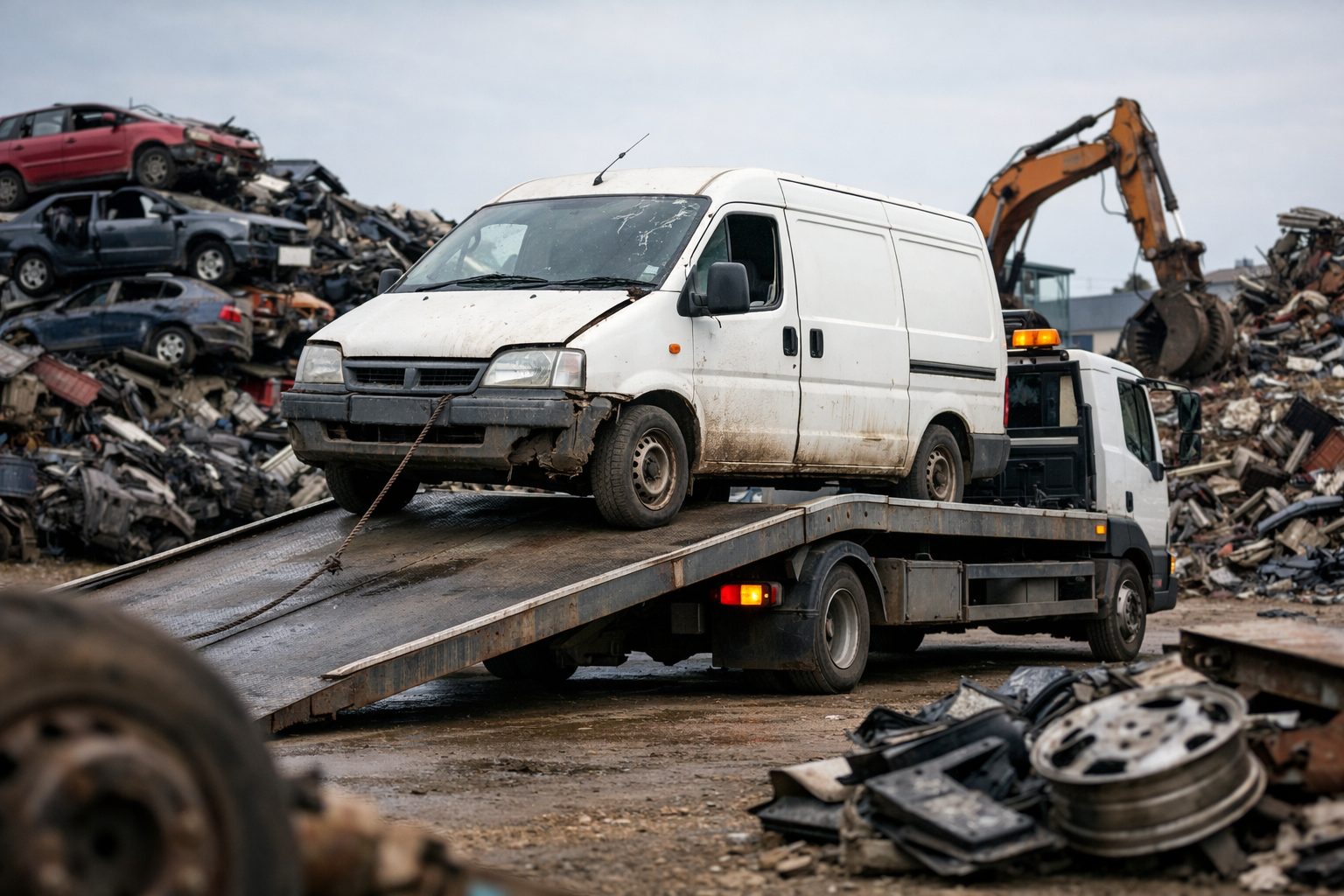
- Flatbed recovery trucks — the van is winched or dragged onto a low-loader flatbed. This works for vans that are seized, have flat tyres, or have no engine compression whatsoever.
- Winch-assisted loading — for vans that are partially mobile but cannot drive, a powered winch cable is attached and the vehicle is pulled onto the bed. This handles most non-runner scenarios without needing to push anything.
The collector needs to know in advance that the van is a non-runner. Not as a confession — just as logistics. A standard tow truck turning up to collect what it thought was a runner will leave again, because it literally cannot take the vehicle. Tell them upfront. It is not embarrassing. They do this every single day.
When you book, specify whether the van has flat tyres, a seized handbrake, or is sitting on its rims. Each of these changes the recovery method slightly, and a good collector will send the right equipment first time rather than making two trips.
What Happens If the Van Is on Private Land
This is the question nobody asks until the collector is standing in the road looking at a van that is inside a locked unit, at the back of a yard, or wedged between a fence and a skip in a way that seemed perfectly logical three years ago when it was parked there.
Private land collection — driveways, garages, industrial yards, farmyards — is completely standard for scrap non running van collection UK operators. The key variables are:
- Access width — a flatbed recovery truck needs roughly 3 metres of clear width to operate. If your van is in a narrow alley or a single-width garage, mention this. The collector may bring a smaller vehicle or different equipment.
- Overhead clearance — a van being winched onto a flatbed sits higher than it normally would during loading. Low garage doors and overhead beams are the enemy of a smooth collection.
- Ground surface — a winch works on concrete and tarmac without drama. Soft ground, mud, or gravel can cause the recovery vehicle itself to sink, which is a situation that escalates from “inconvenient” to “two recovery trucks” with remarkable speed.
- Distance from the road — the further the van is from where the recovery truck can park, the more complex (and occasionally more expensive) the recovery becomes.
None of these things are dealbreakers. They are just information. A reputable collector who specialises in this kind of work will ask about them before quoting — and if they don’t ask, you should volunteer the information anyway, because surprises on collection day help nobody.
How the Price Is Calculated When Your Van Won’t Start
Normally, a scrap yard or collector will assess a vehicle running: they listen to the engine, check whether it drives, and factor the condition into the quote. With a non-runner, that assessment changes — but not as dramatically as you might fear.
For a van that cannot be assessed running, the price is based on:
- Kerb weight — the van’s listed weight from the V5C or manufacturer data. This gives the baseline scrap metal tonnage.
- Visual condition — is the bodywork largely intact? Are the catalytic converter, wheels, and battery still present? Missing components reduce the value because they reduce the recoverable metal.
- Engine and drivetrain — even a seized engine has scrap value. The block, the gearbox casing, and the ancillaries are all metal. A dead engine is not worthless.
- Fuel type — diesel vans tend to have heavier engine components than petrol equivalents, which can marginally affect the calculation.
What collectors won’t pay a premium for is an engine that runs. They’re not buying it to drive it. So the gap between a runner and a non-runner, in pure scrap terms, is smaller than most people expect.
If you want to understand the full process before you commit, the scrap my van page covers what information you’ll need ready and what the collection process looks like from quote to Certificate of Destruction.
Be wary of any collector who quotes you a dramatically lower price specifically because the van is a non-runner and cannot be “tested.” Scrap metal weight doesn’t care whether the van starts. A significantly reduced offer on that basis alone is a negotiating tactic, not an accurate valuation.
The Paperwork Still Matters — Even If the Van Is Dead
A non-running van is still a registered vehicle. The DVLA still knows it exists. And until a licensed Authorised Treatment Facility (ATF) — a regulated site permitted to legally destroy end-of-life vehicles — crushes it and issues a Certificate of Destruction (CoD), you are still technically the registered keeper.
This matters because:
- Road tax and SORN — if the van is off the road, it should be declared SORN (Statutory Off Road Notification). If it isn’t, you may be accumulating fines while it sits there.
- Insurance — a van on private land that isn’t SORNed may still need some level of insurance depending on your circumstances.
- The Certificate of Destruction — this is the document that formally removes the vehicle from your name and confirms it has been legally destroyed. Without it, the van is still yours in the eyes of the DVLA. A legitimate collector will always provide one. An illegitimate one won’t, and that’s how people end up with letters about vehicles they thought they’d scrapped three years ago.
Keep your V5C handy. If you’ve lost it, you can get a replacement reference number from the DVLA, or in some cases the collector can work with the chassis number. But sort this before collection day, not during it.
How to Book a Collection for a Non-Runner Van
The process is straightforward. It is not complicated. It does not require specialist knowledge, a degree in logistics, or the ability to explain to a recovery driver why the van is where it is (though that last one may prove useful).
Get a quote
Contact a specialist collector — ideally one that explicitly handles non-runner vans and broken-down vehicles. Give them the make, model, year, approximate weight, and — critically — the fact that it is a non-runner. Describe the access situation honestly.
Confirm the logistics
Agree on the collection method (flatbed, winch), the access requirements, and the date. If there are any complications — soft ground, low clearance, a gate that needs to be unlocked — confirm who is responsible for what.
Have the paperwork ready
V5C (logbook), your ID, and any SORN documentation. The collector will need to see these before they take the vehicle.
Hand over the van and receive your Certificate of Destruction
The van gets loaded, you get paid (usually on the day or by bank transfer shortly after), and the collector provides the CoD. Notify the DVLA that the vehicle has been scrapped — you can do this online in about four minutes.
That’s it. The van that has been silently judging you from the driveway for eighteen months is gone, you have money, and your neighbours will almost certainly like you more.
Frequently Asked Questions
Will I get less money for a scrap van that won't start?
Not significantly, no. Scrap value is driven by weight and metal content, not by whether the engine runs. You may see a small reduction if the collector needs to bring specialist recovery equipment, but the difference between a runner and a non-runner in pure scrap terms is usually modest. If someone quotes you dramatically less purely because it won’t start, get a second opinion.
Can you collect broken down van for scrap if it's in a garage or on private land?
Yes. Private land collection is completely standard. The collector needs to know the access situation in advance — specifically the width, overhead clearance, and ground surface — so they bring the right equipment. A flatbed truck needs room to manoeuvre, but most residential and commercial situations are manageable with the right preparation.
What if I need to scrap a van that won't start and I've lost the V5C?
You can apply for a replacement V5C from the DVLA, or in many cases the collector can work from the vehicle’s VIN (Vehicle Identification Number), which is stamped on the chassis. The key thing is that the vehicle must go to a licensed ATF and a Certificate of Destruction must be issued — the paperwork route to get there can vary, but it exists.
How does non-runner van disposal UK work for vehicles that are completely seized?
A completely seized van — one that won’t roll at all — is collected using a flatbed truck with a powered winch. The winch cable attaches to the van’s tow points or chassis, and the vehicle is dragged onto the bed without needing to move under its own power. The collector needs to know in advance so they bring the right vehicle.
How long does the collection process take on the day?
For a straightforward collection with good access, the physical loading of a non-runner onto a flatbed takes roughly 20 to 45 minutes. The whole visit — including paperwork — is typically under an hour. Collections from complicated locations (deep in a yard, on soft ground, in a narrow space) can take longer, but this is the exception rather than the rule.
Do I need to be present for the collection?
In most cases, yes — you need to hand over the V5C and sign the relevant documentation. Some collectors will work with a nominated representative if you genuinely cannot be there, but you should arrange this explicitly in advance. Do not just assume someone else can deal with it and then disappear, because the paperwork won’t complete itself.
If your van has given up entirely and is now doing its best impression of a garden ornament, the sensible move is to book a collection with a specialist who handles exactly this kind of thing. Get a quote, describe the access honestly, have the V5C ready, and let someone with a flatbed truck and a winch deal with the problem you’ve been walking past for months. The van goes, the money arrives, and the driveway becomes a driveway again.