You lost your V5C logbook. Now you’re wondering whether that van sitting on your driveway can even be legally scrapped. The answer is yes — you can scrap a van without a V5C. But there are specific steps you must follow to stay on the right side of DVLA rules and get paid without a hitch.
- You do not need a V5C to scrap a van — licensed Authorised Treatment Facilities (ATFs) can accept vehicles without one
- Alternative documents such as a V62, bill of sale, or insurance certificate can confirm ownership at the ATF
- You must still notify the DVLA that the vehicle has been scrapped, even without a logbook
- Scrapping without the V5C can slightly affect the process but should not affect your scrap payment
- Using an unlicensed buyer without proper paperwork leaves you legally exposed — always use a licensed ATF
Why the V5C Matters — and Why Its Absence Isn’t a Dealbreaker
The V5C — officially the Vehicle Registration Certificate, commonly called the logbook — is the document that records a vehicle’s registered keeper with the DVLA. It is not proof of ownership in the legal sense. That distinction matters enormously when you want to scrap a van without a V5C.
Because the V5C records the keeper, not necessarily the owner, DVLA rules and ATF procedures do have provisions for vehicles presented without one. A licensed ATF — an Authorised Treatment Facility, which is a DVLA-approved scrap yard — is legally permitted to accept your van even if the logbook is missing, lost, or never in your possession in the first place.
The V5C is not a title deed. Losing it does not mean you have lost the right to scrap your van. It means you need to follow a slightly different process.
What Alternative Proof of Ownership Is Acceptable at an ATF?
ATFs need to satisfy themselves that you are entitled to dispose of the vehicle. Without a V5C, the following documents are typically accepted as supporting evidence:
- A V62 application form — this is the DVLA’s own form for applying for a replacement V5C, and presenting it alongside other evidence shows you are the legitimate keeper
- A bill of sale or purchase receipt — dated paperwork showing you bought the van, ideally with the seller’s details
- Motor insurance certificate — a current or recent policy in your name for that specific vehicle
- Finance settlement letter — if you paid off a finance agreement, a letter confirming the vehicle is clear of finance
- Hire purchase or lease documentation — confirming the vehicle transferred to your ownership
No single alternative document is universally guaranteed — each ATF has its own internal compliance checks. Call ahead, explain your situation, and ask exactly what they need. A reputable ATF will tell you plainly.
Bring two or more supporting documents rather than relying on one. The more evidence you can show, the smoother the handover will be.
How to Notify the DVLA When You Scrap a Van Without a Logbook
This is the step most guides gloss over. Even without a V5C, you have a legal obligation to tell the DVLA the vehicle has been scrapped. Failure to do so can leave you liable for Vehicle Excise Duty (road tax) on a van you no longer own.
Here is the exact process:
Confirm the ATF will issue a Certificate of Destruction
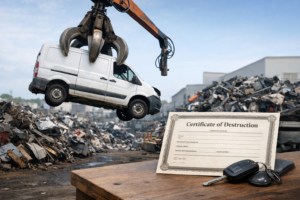
Before you hand the van over, confirm the ATF is licensed and will issue a Certificate of Destruction (CoD). This is a legal requirement under the End of Life Vehicles Regulations 2003. A licensed ATF issues it automatically. An unlicensed buyer cannot issue one — which is a serious red flag.
Hand the van over to the ATF
At the point of collection or drop-off, the ATF logs the vehicle against its licence. They record the van’s VIN (Vehicle Identification Number), registration, and your details. Without a V5C, the VIN stamped on the chassis or visible through the windscreen is the primary identifier.
The ATF notifies the DVLA directly
Licensed ATFs are required to notify the DVLA electronically when a vehicle is destroyed. This triggers the DVLA’s records to show the vehicle as scrapped. You do not need to send in the green slip from the V5C (because you do not have one), and you do not need to fill in a separate DVLA form — the ATF’s notification covers it.
Check for a DVLA acknowledgement
Within a few weeks, the DVLA typically sends a letter to the registered keeper confirming the vehicle has been taken off the road. If you are the registered keeper, watch for this. If you bought the van privately and the previous keeper never updated the V5C, contact the DVLA directly to confirm the record has been updated.
Cancel your road tax and claim a refund
Road tax does not transfer between owners. Once the van is scrapped, any remaining full months of Vehicle Excise Duty are automatically refunded to the registered keeper. If that is you, the refund goes to the address on DVLA’s records. If the V5C was never updated to your name, this is another reason to contact the DVLA before scrapping.
Do not assume the DVLA will update its records without the ATF’s notification. Always ask the ATF to confirm they have submitted it, and keep your Certificate of Destruction safe as proof.
What Happens If You Have No Documents at All?
Selling a van with no documents — no V5C, no insurance certificate, no purchase receipt — is harder but not impossible. This is the scenario covered by van scrappage without registration document in its truest sense.
If you genuinely have no paperwork, the ATF will rely heavily on the vehicle’s VIN. They will cross-reference it against the DVLA’s records to confirm there are no flags — stolen vehicle markers, outstanding finance, or an active insurance write-off status. If the VIN is clear, many licensed ATFs will proceed, though some may require a statutory declaration confirming you are the lawful owner.
A statutory declaration is a formal written statement made in front of a solicitor or commissioner for oaths. It costs around £5–£15 and carries legal weight. It is a practical solution when you genuinely have no other documentation.
If you are ready to move forward, you can get a quote to scrap your van and find out exactly what information is needed before collection — no paperwork guesswork required.
Does Scrapping a Van Without a V5C Affect the Scrap Price?
No — the scrap value of your van is based on its weight, the current price of scrap metal, and the condition of salvageable parts. None of those factors change because you have lost the logbook.
What can affect the price is if the missing V5C is a symptom of a wider problem — for example, if the van has a finance marker against it or was previously written off. Those issues affect value regardless of whether you have the logbook. A straightforward lost logbook, with your ownership otherwise verifiable, will not reduce your payout.
How to Avoid Scams When You Sell a Van With No Documents
The phrase sell van no documents attracts a small number of unscrupulous buyers who rely on sellers feeling desperate or uninformed. Protect yourself:
- Only use a licensed ATF. Check the Environment Agency’s public register of licensed waste carriers and ATFs. A legitimate buyer will have no objection to you verifying their licence.
- Never hand over a van without receiving a Certificate of Destruction. This is your legal protection. Without it, the van remains on DVLA records and any future liability could follow you.
- Avoid cash-only buyers who ask no questions. A buyer who is unconcerned about your lack of documentation and pays cash with no paperwork is almost certainly unlicensed.
- Get the quote in writing before collection. Reputable ATFs confirm the scrap value upfront. Last-minute price reductions at the point of collection are a known tactic among rogue traders.
Frequently Asked Questions
Can I scrap a van if I never had the V5C in my name?
Yes. If you bought a van and the previous keeper never updated the V5C to your name, you can still scrap it. Bring your purchase receipt, any insurance documents in your name, and explain the situation to the ATF. They will cross-reference the VIN with DVLA records. It is also worth applying for a replacement V5C using a V62 form before scrapping — it costs £25 and can simplify the process significantly.
How do I get a replacement V5C before scrapping?
Apply online via the DVLA’s V62 form or post the completed form to DVLA, Swansea, SA99 1DZ with the £25 fee. Processing typically takes around six weeks. If your van is roadworthy and you can wait, this is the cleanest route. If the van is not driveable and you need it gone quickly, proceed with the ATF using alternative documentation instead.
What is a Certificate of Destruction and why do I need it?
A Certificate of Destruction (CoD) is a legal document issued by a licensed ATF confirming your van has been permanently destroyed. Under the End of Life Vehicles Regulations 2003, you are entitled to receive one free of charge. It removes the vehicle from DVLA records, protects you from future liability, and confirms you fulfilled your legal duty. Never scrap a van without receiving one.
Will I still get a road tax refund if I scrap a van with no logbook?
Yes, provided you are the registered keeper on DVLA’s records. The refund is triggered automatically when the ATF notifies the DVLA of the destruction. If the V5C was never updated to your name, the refund may go to the previous keeper — another reason to get the V5C updated before scrapping if time allows.
Is it legal to scrap a van without a V5C?
Yes, it is completely legal. There is no law requiring you to present a V5C to scrap a vehicle. The legal requirements are that the van is disposed of through a licensed ATF and that the DVLA is notified — both of which the ATF handles as part of the standard process. The V5C is a helpful document, not a legal prerequisite for scrapping.
What if the van is on finance — can I still scrap it?
No — not without settling the finance first. A van on active finance is owned by the finance company, not you. Scrapping it without their consent is illegal and could constitute fraud. Contact the finance provider, request a settlement figure, and obtain written confirmation that the vehicle is clear of finance before approaching an ATF.
If your van is sitting unused and the missing logbook has been the only thing stopping you from acting, now you have the full picture. Gather whatever ownership documents you have, call a licensed ATF, and get the process started. The paperwork is manageable — and the van does not need to keep taking up space.