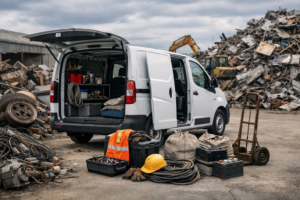

Selling your van before buying a new one is almost always the right call — but only if you sort the timing, because doing it in the wrong order is how perfectly sensible tradespeople end up standing on a pavement watching their livelihood disappear into a transporter while their replacement vehicle is still three weeks from delivery. Here’s how to get the sequencing right.
- Selling first gives you a firm budget and real negotiating power, but it creates a vehicle gap that can kill your income if you haven’t planned for it
- Part exchange sounds convenient but costs you money — often a lot of it — in exchange for that convenience
- The sequencing problem (sell first vs. buy first) is the thing nobody talks about, and it’s the thing most likely to go wrong
- A fast-purchase buyer who can complete in days removes the timing risk entirely, which is why they’re worth considering even if the headline price looks lower
- The gap between selling and collecting your new van is a logistics problem, not a reason to panic — if you’ve planned for it
The sell-first-or-buy-first problem nobody warns you about
The answer is: sell first, almost always. But — and this is a but large enough to park a Sprinter in — “sell first” only works if you’ve solved the gap problem before you start.
Most advice on this subject stops at “selling first gives you more leverage.” Which is true, and also about as useful as telling someone to “just be more confident.” The real question isn’t whether to sell first. It’s how to sell fast enough that you’re not stranded without a working vehicle for two weeks while your new van sits at a dealership waiting for paperwork.
This is the sequencing problem. And it’s what makes the decision to sell van before buying new van UK so much more complicated than it looks on a comparison website.
Why selling first puts you in a stronger position
Selling first means you know exactly what you have to spend. Not approximately. Not “the dealer said it’s worth about this.” Exactly. And when you walk into a dealership knowing your precise budget — cash in hand, no trade-in to negotiate, no part exchange to haggle over — you are a fundamentally different kind of customer.
Dealers like cash buyers. They like them the way cats like a warm radiator: unconditionally, and with very little effort on your part. You can negotiate harder, walk away more easily, and refuse finance products you don’t need, because you’re not dependent on their valuation of your old van to make the numbers work.
There’s another benefit that gets overlooked: you can take your time choosing the right replacement. When you’re part-exchanging, you’re locked into whatever that dealer has on the forecourt, because you need to do both transactions simultaneously. Sell first, and you can spend a fortnight comparing vans across fifteen different dealers without the clock ticking.
Get at least three valuations before you sell — from a dealer, from an online instant-buyer, and from a private sale estimate. The spread between them will tell you exactly how much convenience is costing you.
What part exchange actually costs you
Part exchange is the van equivalent of a ready meal. Yes, it solves the immediate problem. Yes, it’s convenient. And yes, you will pay for that convenience in ways that aren’t immediately obvious when you’re standing in a showroom being told it’s “the easiest option.”
The average part-exchange valuation is typically several hundred to several thousand pounds below private sale value, depending on the van’s age, condition, and how much the dealer wants to shift the new vehicle. That gap doesn’t disappear — it just gets buried in the finance agreement or the headline price of the new van, where you’re less likely to notice it.
Part exchange also removes your negotiating position on the new vehicle entirely. You’re now doing two deals simultaneously, which means the dealer can adjust either number to make the overall package look attractive while keeping their margin intact. It’s not dishonest. It’s just how it works. And knowing how it works is the difference between a good deal and a politely expensive one.
For vans that are older, higher-mileage, or carrying some damage, the part-exchange valuation can be genuinely insulting. In those cases, exploring specialist buyers who purchase vans in any condition is often the more rational van replacement strategy — you get a real number quickly, and you’re not dependent on a dealer’s goodwill.
How to avoid the gap in vehicle availability
This is the bit where people panic, and the panic is understandable. You’ve sold your van. Your new van isn’t ready. You have a job on Tuesday. What now?
The answer is: plan for the gap before you sell, not after. Specifically:
- Agree a collection date, not just a sale date. Many buyers — especially fast-purchase companies — will let you choose when they collect, which means you can align the handover with your new van’s delivery date.
- Hire a van for the gap period. Daily van hire in the UK runs from roughly £60–£120 per day depending on size and location. For a five-day gap, that’s £300–£600 — almost certainly less than you’d lose on a bad part exchange.
- Borrow or share a vehicle short-term. If you work with other tradespeople, a temporary arrangement is often possible and costs nothing except a favour owed.
- Use the gap productively. Admin, quotes, materials ordering — not everything requires a van. A planned gap is a chance to catch up on the stuff that always gets pushed back.
The gap is only a crisis if you haven’t seen it coming. See it coming.
Do not agree to hand over your van before you have either confirmed delivery of the new one or a concrete plan for the interim period. “It should be ready by then” is not a plan.
When to time your van upgrade
The best time to upgrade your van is when at least two of these three things are true:
- Your current van’s reliability is declining — not “it had one problem” but “it’s becoming unpredictable,” which in a working vehicle is a different category of problem entirely
- Repair costs are approaching or exceeding the van’s value — the classic sunk-cost trap is spending £1,200 on a van worth £1,800, then spending another £900 three months later
- Your business has grown beyond what the van can do — capacity, payload, towing, refrigeration, whatever the specific requirement is
Van upgrade timing also has a seasonal dimension. Vans sell better in spring and early summer — more buyers, more competition, better prices. Selling in November is not impossible, but you will work harder for the same result.
There’s also the question of finance. If you’re planning to finance the new van, your credit position, the interest rate environment, and whether you have a deposit ready all affect when “now” is actually the right time.
Selling privately vs. using an instant buyer
Private sale gets you the best price. It also requires advertising, fielding calls from people who want to offer you £400 less “because of the tyres,” arranging viewings, accepting cash or bank transfers from strangers, and doing all of this while running a business.
Instant buyers — companies that give you an online quote and collect the van — get you a lower price and take the entire process off your hands. The question is whether the time and stress saved is worth the difference in price.
For a van in good condition with a strong private market, the difference can be meaningful enough that private sale is worth the effort. For an older van, a high-mileage van, or a van with known issues, the private sale market is thinner, the viewings are more painful, and the instant-buyer price starts to look considerably more reasonable.
The van part exchange alternative that most people overlook is using an instant buyer specifically to solve the timing problem — not because it’s the highest price, but because it gives you a confirmed date, a confirmed amount, and zero uncertainty. In a situation where timing risk is your main concern, that certainty has real value.
Frequently Asked Questions
Should I sell my van before buying a new one?
Yes, in most cases. Selling first gives you a confirmed budget, stronger negotiating power on the new purchase, and the freedom to shop across multiple dealers without being tied to a simultaneous part exchange. The main risk is the gap in vehicle availability — which is manageable if you plan for it before you sell, not after.
How long does it take to sell a van privately in the UK?
It varies considerably depending on make, model, condition, and asking price. A popular mid-range van in good condition — a Ford Transit Custom or Vauxhall Vivaro, for example — can sell within a week if priced correctly. Older, higher-mileage, or more specialised vans can take four to eight weeks. If your timeline is tight, an instant buyer will complete in two to five working days.
Is part exchange ever worth it?
Occasionally, yes. If a dealer is running a promotion that inflates their part-exchange valuations, or if your van is in genuinely excellent condition and the dealer wants it for their forecourt, the gap between part exchange and private sale can narrow significantly. But as a general rule, part exchange trades money for convenience — and it’s worth knowing exactly how much money before you decide the convenience is worth it.
What's the best way to avoid being without a van between selling and buying?
Agree a flexible collection date with your buyer so you can align the handover with your new van’s delivery. If there’s still a gap, short-term van hire is the cleanest solution — budget for it as a cost of the transaction rather than treating it as an unexpected expense.
Does selling first affect my ability to get finance on a new van?
No — your ability to get finance depends on your credit history, income, and the lender’s criteria, not on whether you’ve already sold your old van. In fact, having cash from the sale available as a deposit can improve the terms you’re offered.
When is the worst time to sell a van in the UK?
The period between mid-November and mid-January tends to produce the slowest market and the most price-sensitive buyers. If you have any flexibility on timing, selling in spring or early autumn will typically produce better results with less effort.
If you’re ready to move on from your current van and want a confirmed price without the uncertainty, getting a fast online quote is the obvious first step — it costs nothing, gives you a real number to plan around, and puts you in control of the timing rather than at the mercy of it.