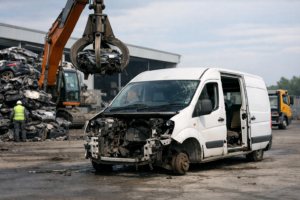
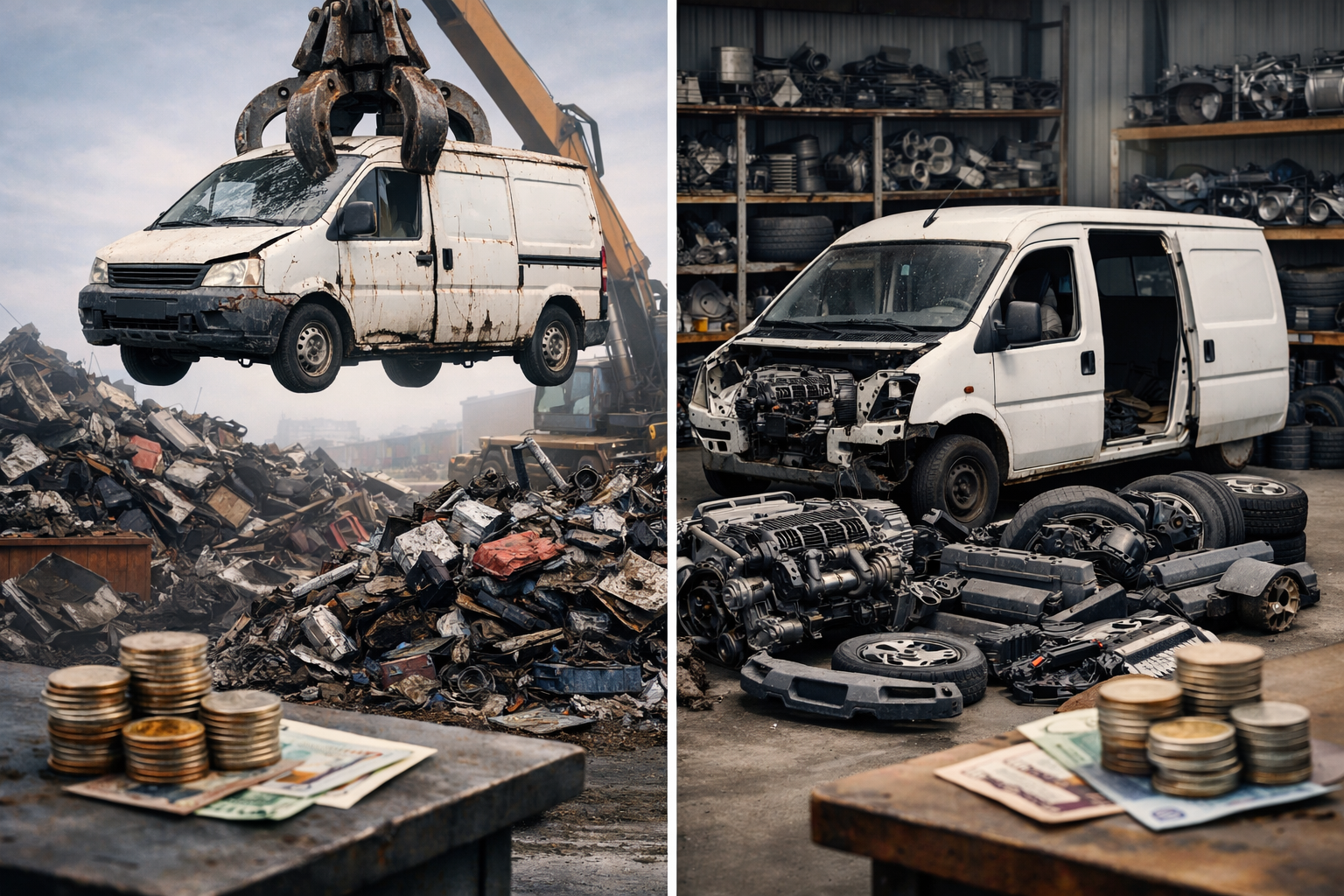
Scrapping your van pays you today, typically £150–£400 for a standard van, with zero effort beyond a phone call. Selling it for parts can earn more in total, but the honest answer is: it rarely does, once you account for your time, storage, listing fees, and the parts that never sell. Here is the full picture.
At a glance: scrap van vs sell for parts
| Factor | Scrap the van | Sell for parts |
|---|---|---|
| Upfront cash | £150–£400 (same day) | £0 until parts sell |
| Total potential return | Fixed | Higher ceiling |
| Time investment | 1–2 hours | 20–100+ hours |
| Storage needed | None | Significant |
| Specialist knowledge | None | Moderate to high |
| Listing fees | None | eBay, Facebook, etc. |
| Risk of unsold stock | None | High on slow-moving parts |
| Best for | Anyone wanting certainty | Experienced mechanics with space |
Option 1: Scrapping your van
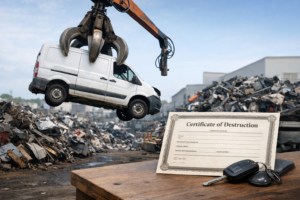
Scrapping a van means selling it to an Authorised Treatment Facility (ATF) — a licensed dismantler or scrap yard — which pays you by weight and issues a Certificate of Destruction (CoD) to remove the vehicle from your name legally.
What you get
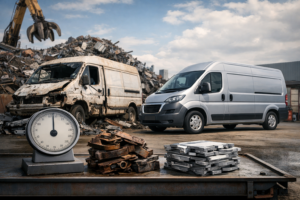
The price is set by the current scrap metal rate multiplied by your van’s kerb weight. A typical transit-sized van runs 1,500–2,000 kg, which translates to roughly £150–£400 at current rates. Prices shift with the steel market, so it pays to get three quotes before you commit.
Pro tip
Always use an ATF registered with the Environment Agency. Unlicensed buyers may offer slightly more, but you remain legally responsible for the vehicle if it is not properly destroyed.
Strengths
- Cash in hand, often the same day or next day
- No storage, no listing, no negotiation with tyre-kickers
- CoD removes all future liability — DVLA is notified automatically
- Works even if the van is a non-runner or badly damaged
Weaknesses
- The price ceiling is low — you will not beat a good parts sale on total return
- Scrap rates fluctuate; a bad week can cost you £40–£60
- Catalytic converters and batteries are sometimes excluded from the quote
Who should scrap their van
Scrapping is the right call if your van is high-mileage, structurally corroded, or if you simply need the problem gone this week. It is also the clear winner if you have nowhere to store a stripped shell and no tools to do the work.
Option 2: Selling your van for parts
Breaking a van for parts — sometimes called parting out or a van scrap or dismantle — means removing individual components and selling them separately. The theory is sound: the sum of the parts exceeds the whole. In practice, the margin is thinner than most guides admit.
What you can realistically earn
A well-specified van in reasonable condition might yield £800–£1,500 across all parts — engine, gearbox, alternator, seats, wheels, mirrors, ECU, and so on. But “might” is doing heavy lifting in that sentence. Fast-moving parts (engines, gearboxes, wheels) sell within days. Slow-movers (interior trim, obscure sensors, body panels for less common models) can sit for six months or never sell at all.
Warning
Unsold parts are not free to hold. Storage space has a cost, even if it is your own driveway. Parts left outside deteriorate. After six months, a trim panel worth £40 may be worth nothing.
The hidden costs of parting out
This is where most guides go quiet. Before you count your profit, subtract:
- eBay fees: roughly 12–15% of each sale, plus PayPal or payment processing
- Postage and packaging: buyers expect free or cheap delivery; you absorb the difference
- Your time: stripping a van properly takes 20–40 hours of physical work, plus listing, messaging buyers, and dispatching parts
- Unsold parts: realistically, 20–40% of parts on a common van may not sell within a sensible timeframe
Run the numbers honestly and the net return on a typical van is often £400–£700 — better than scrap, but not by the margin the headline figure suggests.
Strengths
- Higher ceiling on total return, especially for popular van models (Ford Transit, VW Transporter, Mercedes Sprinter)
- Satisfying if you enjoy the work and have the skills
- Individual rare parts can command strong prices
Weaknesses
- Significant time commitment — weeks, not days
- Requires tools, space, and mechanical knowledge
- Cash flow is slow and uneven
- Listing fatigue is real: dozens of separate adverts to write, photograph, and manage
Who should sell for parts
Breaking a van for parts makes sense if you are a mechanic or experienced DIYer with a garage, a van that carries desirable components (low-mileage engine, rare trim), and the patience to see the process through over several weeks. If any one of those conditions is missing, the maths rarely work in your favour.
Head-to-head comparison by key criteria
Speed of return
Scrapping wins outright. A call in the morning, a collection in the afternoon, cash (or bank transfer) the same day. Parting out delivers money in dribs and drabs over weeks or months.
Net cash after costs
This is closer than it looks. If you factor in fees, postage, unsold stock, and your time at even a modest hourly rate, parting out a typical van may net you £200–£400 more than scrapping — not the £600–£900 difference the gross figures imply.
Effort and expertise
Scrapping requires none. Parting out requires both. If you have never stripped a van before, factor in mistakes, stripped bolts, and parts damaged during removal that you cannot sell.
Environmental outcome
Both routes are broadly responsible. ATFs are legally required to depollute and recycle. Parting out also keeps usable components in circulation, which has genuine environmental value — though the difference is marginal.
Legal compliance
Scrapping via an ATF handles everything: DVLA notification, CoD, depollution. When breaking a van for parts, you remain responsible for disposing of the shell, fluids, and tyres correctly. Fly-tipping a stripped shell is a criminal offence.
Our Verdict
Scrapping is the right default for most people. The certainty, speed, and zero-effort process are worth more than the modest extra return that parting out might deliver — especially once you account for the real costs.
Parting out beats scrapping only in a specific scenario: you have a popular van model with a low-mileage drivetrain, you have the tools and space to do it properly, and you are prepared to invest 30–60 hours over several weeks. In that case, the extra net return — realistically £200–£400 — may justify the effort.
If you want to explore what scrapping your van would actually pay, the scrap my van service at We Buy Broken Vans gives you a fast, no-obligation quote with no hidden deductions — worth having as a benchmark even if you are still weighing your options.
For everyone else — the van that will not start, the fleet vehicle past its useful life, the van you just need gone — scrapping is the best way to dispose of a broken van cleanly, legally, and quickly.
Key takeaways
- Scrapping pays £150–£400 with same-day collection and zero effort
- Parting out has a higher ceiling but hidden costs (fees, time, unsold stock) erode the margin significantly
- Net return from breaking a van for parts is realistically £200–£400 more than scrapping — not the thousands some guides imply
- Parting out only makes sense if you have mechanical skills, storage, and a popular van model
- Always use a licensed ATF when scrapping to receive a Certificate of Destruction and clear your legal liability
Frequently Asked Questions
Is it worth breaking a van for parts in the UK?
It depends on three factors: the van’s make and model, your mechanical ability, and how much your time is worth. Popular models like the Ford Transit or VW Transporter have strong parts demand. For rarer or older vans, demand is thin and you may struggle to sell the majority of components. If your time has any value to you, scrapping will often match or beat the net return from breaking a van for parts in the UK.
What is the best way to dispose of a broken van?
For most owners, the best way to dispose of a broken van is to sell it to a licensed scrap buyer or ATF. You get a Certificate of Destruction, the DVLA is notified, and you are free of the vehicle the same day. Parting out is only worth considering if the van has a desirable, low-mileage drivetrain and you have the skills to remove and sell components yourself.
How much do you get for scrapping a van?
Scrap prices are based on the van’s weight multiplied by the current scrap metal rate. A typical large van (1,500–2,000 kg) fetches £150–£400 at current rates. Prices vary by region and fluctuate with the steel market, so getting two or three quotes before you commit is worth the five minutes it takes.
Can I scrap or dismantle a van myself and sell the parts legally?
Yes, you can legally strip and sell parts from a van you own. However, you remain responsible for disposing of the shell, fluids, and tyres correctly — dumping them is illegal. You do not need an ATF licence to sell individual parts privately, but if you do it regularly and commercially, HMRC may consider it a trading activity subject to tax.
What parts from a van sell fastest?
Engines and gearboxes sell fastest, often within 48 hours of listing if the price is right. Alloy wheels, alternators, starter motors, and ECUs also move quickly. Body panels, interior trim, and minor electrical components are the slowest movers — and the parts most likely to sit unsold at the end of the process.
Does scrapping a van affect my insurance?
Yes. Once you receive a Certificate of Destruction, notify your insurer immediately. You may be entitled to a refund on the unused portion of your premium. If you do not inform them, you could be paying for cover on a vehicle that no longer legally exists.
Disclosure: This article may contain affiliate or referral links. These do not affect the independence of our recommendations.