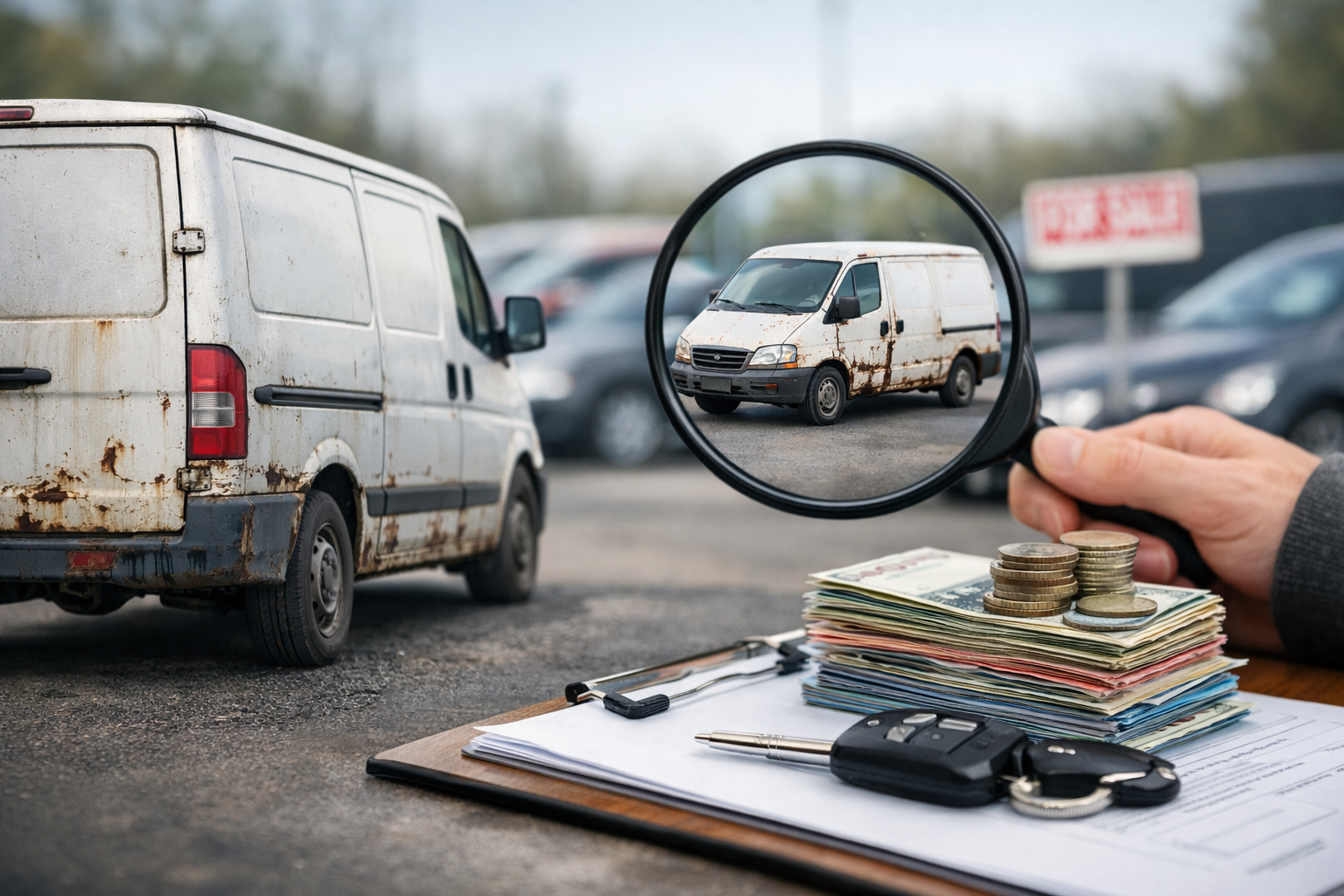
You’ve got a van that looks like it lost a fight with a skip lorry, runs like a pensioner after a heavy lunch, and smells faintly of something you’d rather not identify. The question — the only question that actually matters — is: how much is anyone going to give you for it?
If you’re trying to sell a van in poor condition in the UK, the honest answer is somewhere between “not as much as you’d hope” and “more than you probably fear.” The exact number depends on factors that are entirely predictable, entirely logical, and almost entirely ignored by every other article on this subject.
Let’s fix that.
Key takeaways
- A van in poor condition will typically fetch between 20% and 60% of its clean-market value, depending on the type and severity of damage
- Cosmetic damage hurts your price less than mechanical failure — buyers can sand rust, they can’t easily rebuild a gearbox
- Scrapping is rarely the best financial outcome unless the van is genuinely beyond economic repair
- Getting multiple quotes takes about twenty minutes and can make a difference of hundreds of pounds
- Honest disclosure of condition upfront saves you from having offers slashed at the point of collection
What “poor condition” actually means — and why it matters for your price
“Poor condition” is doing a lot of heavy lifting as a phrase. It covers everything from a cracked wing mirror to a van that requires a tow truck just to leave your driveway. Buyers, quite reasonably, treat these things differently.
The industry broadly sorts condition into four grades: excellent, good, fair, and poor. A van in “poor” condition is one with multiple issues — think high mileage combined with visible bodywork damage, a worn interior, mechanical faults, or a history of neglect that shows up in the service records (or the suspicious absence of them). A van with one of those problems is probably “fair.” A van with all of them is definitely poor.
Why does the distinction matter? Because buyers price risk. The more problems stacked on top of each other, the less confident a buyer is about what they’re really getting — and the lower their offer goes to compensate for that uncertainty.
How much is a van in bad condition actually worth?
Here is the number most articles refuse to give you: a van in genuinely poor condition is typically worth 20% to 50% of its clean retail value. A van with only cosmetic issues — dents, scratches, faded paint, a worn interior — might hold closer to 50% to 65% of its clean value. A van with serious mechanical problems, failed MOT, or structural rust drops toward the lower end of that range, sometimes below it.
To put that in concrete terms: if a clean, well-maintained version of your van would sell privately for £8,000, you’re looking at somewhere between £1,600 and £5,200 depending on what’s wrong with it. That’s a wide range, yes. But it’s a real range, not a vague shrug dressed up as advice.
Note
These figures assume a reasonable age and make. A 2010 Transit with 180,000 miles and a cracked dashboard is a different proposition to a 2019 Sprinter with a dented bumper. Age compounds condition problems — the older the van, the more aggressively condition discounts apply.
The specific things that kill your van’s value (and by roughly how much)
Not all damage is equal. Here’s how different condition problems typically affect what a buyer will offer:
Cosmetic damage (dents, scratches, faded paint, minor rust patches)
This is the least catastrophic category. Buyers who flip vans for resale can repair cosmetic issues relatively cheaply. Expect a deduction of roughly £200 to £800 depending on severity — annoying, but survivable.
Worn interior (ripped seats, broken trim, damaged load area lining)
A poor condition van price takes a hit here, but again, it’s manageable. Interior refurbs are labour-intensive but not technically complex. Deductions of £150 to £500 are typical for a badly worn cab; more if the load area is seriously damaged.
Mechanical issues (engine warning lights, gearbox problems, clutch wear, suspension faults)
Now we’re into territory where buyers get nervous. Mechanical repairs are expensive, unpredictable, and sometimes reveal worse problems underneath. A van with known mechanical faults can lose 30% to 50% of its remaining value compared to an identical van with a clean bill of health. A failed MOT on its own can knock £500 to £1,500 off an offer.
Structural rust or accident damage
This is where the van scrap vs sell question starts to become genuinely relevant. Structural rust — chassis rot, sill corrosion, floor pan damage — makes a van unsafe and often uneconomical to repair. If the repair cost exceeds the van’s repaired value, scrapping starts to make financial sense. A Category S or Category N write-off (insurance-declared damage) will also significantly suppress offers from private buyers, though specialist buyers will still make offers.
Van scrap vs sell: which option actually pays more?
Scrapping a van means selling it by weight to a licensed scrap dealer. Current scrap metal prices fluctuate, but as a rough guide, a typical panel van weighing around 1,500–2,000kg might yield £150 to £350 at scrap value. That’s the floor. It’s not nothing, but it’s the absolute minimum.
Selling a worn-out van — even in genuinely terrible condition — to a specialist buyer almost always returns more than scrap. Specialist buyers can part-out vans (selling the engine, gearbox, doors, seats separately), which means they can afford to pay more than a scrap dealer who only cares about tonnage. The difference between scrap value and a specialist offer for the same van is frequently £300 to £800.
The only scenario where scrapping genuinely wins is when the van is so far gone that no buyer wants it whole — severe fire damage, catastrophic accident damage, or rot so advanced that even the parts are compromised. If you’re unsure which camp your van falls into, getting a quote from a specialist van buyer before committing to the scrapyard takes about three minutes and costs nothing.
Pro tip
Always get a scrap quote and a specialist buyer quote on the same day, so you’re comparing like for like. Scrap metal prices move weekly.
Does mileage matter as much as people think?
Yes and no — which I appreciate is exactly the kind of non-answer I promised to avoid, so let me be more specific.
High mileage on its own, in a well-maintained van, is far less damaging than people assume. A 150,000-mile Transit with a full service history and a clean MOT will sell for a reasonable sum. High mileage combined with poor condition is where the wheels fall off, metaphorically and occasionally literally. Buyers see high mileage as a risk multiplier — it amplifies every other concern rather than being a standalone problem.
A van with 200,000 miles and no service history, a warning light on the dash, and a dent in every panel is the trifecta of depreciation. Each problem makes the others worse in a buyer’s calculation.
How to get the best price for a van in poor condition
You’re not going to magic a poor-condition van into a good-condition price, but you can avoid leaving money on the table through entirely preventable mistakes.
- Get at least three quotes. Specialist buyers, scrap dealers, and local traders all value vans differently. The spread between the lowest and highest offer for the same vehicle can easily be £400 to £600.
- Be brutally honest about condition upfront. Buyers who discover undisclosed problems at collection will either walk away or slash their offer on the spot. Neither outcome is fun. Describe every fault accurately and you’ll get accurate offers — no nasty surprises.
- Gather whatever paperwork you have. V5C logbook, MOT certificates, service history, even old receipts for parts. Every document you can produce reduces the buyer’s perceived risk and nudges the offer upward.
- Don’t bother with cosmetic fixes. Spending £200 cleaning and repainting a van that has a blown head gasket is not a sound investment. Fix nothing unless the cost of the repair is demonstrably less than the uplift it creates in the offer.
- Know your absolute floor. Calculate the scrap value of your van before you start getting quotes. That’s your baseline. Any offer above it is profit compared to the alternative.
Warning
Avoid any buyer who asks for payment upfront for “admin fees” or “transport costs” before collecting the van. Legitimate buyers make money on the vehicle, not on you.
Frequently Asked Questions
How much will I get for a van in poor condition in the UK?
Expect between 20% and 50% of the van’s clean market value, depending on the type and severity of problems. A van with only cosmetic damage might reach 65% of clean value; one with serious mechanical or structural issues will sit at the lower end of that range or below it. The single most useful thing you can do is get multiple quotes rather than accepting the first offer.
Is it worth repairing a van before selling it?
Rarely, unless the repair is minor and cheap. The general rule is this: if the cost of the repair is less than the uplift it creates in the sale price, do it. If not, don’t. Cosmetic repairs almost never pay for themselves in a private sale; mechanical repairs almost never do in any sale. Sell the van in its current condition and let the buyer factor in the repair cost.
Can I sell a van that has failed its MOT?
Yes, absolutely. A failed MOT does not prevent a sale — it simply needs to be disclosed, and the van cannot be driven on public roads without a valid MOT (it can be transported on a trailer or by a specialist recovery vehicle). Buyers who purchase vans in poor condition deal with failed MOTs regularly. Expect the failure to reduce your offer, typically by £500 to £1,500 depending on the severity of the advisory items.
What’s the difference between selling and scrapping a worn-out van?
Selling to a specialist buyer almost always returns more money than scrapping, because specialist buyers can recover value from parts rather than just weight. Scrapping makes sense only when the van is so severely damaged that no buyer will take it whole. Get a specialist quote before committing to scrap — you may be pleasantly surprised.
Do I need a V5C to sell a van in poor condition?
You don’t legally need it to complete a sale, but not having one will reduce your offer, sometimes significantly. Buyers use the V5C to verify ownership, check the van’s history, and complete the DVLA transfer. Without it, they’re taking on additional risk, and they’ll price that risk accordingly. If you’ve lost yours, apply for a replacement from the DVLA (V62 form) — it costs £25 and takes a few weeks, which may or may not be worth waiting for depending on your circumstances.
Will a specialist buyer collect a van that doesn’t run?
Most specialist buyers who deal in damaged or poor-condition vans offer free collection, including for non-runners. Confirm this before accepting any offer, and make sure the collection cost isn’t being quietly deducted from the price you were quoted.
If your van is sitting on the drive looking sorry for itself, the worst thing you can do is assume it’s worthless and let it rot further. Get a few quotes, be honest about what’s wrong with it, and you’ll almost certainly walk away with more than you expected — and considerably more than the scrapyard would hand you.